Sunday, August 8, 2010

Review: The Secret Diary of Adrian Mole, Aged 13 3/4, by Sue Townsend


"Teen angst has never been such serious business--or this much fun! In his secret diary, British teen Adrian Mole excruciatingly details every morsel of his turbulent adolescence. Mixed in with daily reports about the zit sprouting on his chin are heartrending passages about his parents' chaotic marriage. Adrian sees all, and he has something to say about everything. Delightfully self-centered, Adrian is the sort of teen who could rule a much better world--if only his crazy relatives and classmates would get out of his way."
Lately a lot of book blogs I nose around have been concerned with reading the classics. I see the sci-fi masterlist being posted everywhere, and more than a few of the non sci-fi blogs I read are tackling some less speculative classics (Pride and Prejudice and Zombies doesn't count). It made me feel like maybe I should stop being such a philistine and start exploring the great literature of days gone by. Should I start with Tolstoy (wasn't he a Bolshevik?), or maybe Dickens? (Would Dan Simmons' Drood count?) Then I started to feel a little lightheaded, so I decided to ease myself in with the Secret Dairy of Adrian Mole, which my coworker Kim told me she had to read in school, and everyone knows its only a classic if you had to read it in school. Plus I bought the book and it's sequels ages ago, so it was already conveniently on my bookshelf. This book falls squarely into the genre that possibly already exists or that possibly I just made up called ‘Thatcher-eqsue.” Thatcher-esque literature, so named for the period under Margeret Thatcher in which is was written, is characterised by the appearance of depressing working class surroundings and a feeling of overwhelming Britishness. And trust me, the Secret Diary of Adrian Mole has both of these things in spades. It's all angst and pence, which now I think about it sounds like a law firm...

I would have to say that The Secret Diary, etc is probably the best example of a book in the form of a diary that I've ever read. Hell, scratch the probably. The things reads like an actual diary. Oftentimes with this style of book the diary entries don't read true, the diary writer (diary-est? diary-er?) might recount solid passages of dialogue, for example, or they might foreshadow upcoming events (which is ok is the book is 'diary of a chick who can see the future,' but otherwise not so much). Townsend displays none of these faults. The only thing that some people might point to as being un-diary like is Adrian's habit of referring to people by their full names instead of using abbreviations. However I am fully onboard with it as 1) it's a writing technique that bugs me and, 2) as a self proclaimed intellectual I believe that young Adrian would write out full names every time.

Now I'm not saying that the book is without flaws, in fact the major complaints I have with it are because it is so true to its diary form. Namely there seems to be no overreaching plot. It's just a self centered kid writing a little bit almost every day about his life. There is not much in the way of traditional narrative road marks, such as a clearly defined beginning, middle and conclusion. Stuff happens, some more stuff happens, and then there are no more pages. There is no real ending, no satisfying conclusion, just no more words. As I said, it reads exactly like a real diary, and when we read the last entry it's prety easy to imagne that Adrian had kept on going in a new journal, (especially considering the three other Adrian Mole books on my shelf). There is character development though. The Adrian in the first entry is not the same Adrian in the last and after all (are you sick of hearing me say this yet?) a book's characters are the most important thing.

I found myself not minding the lack of traditional plot too much, or at all really, because Adrian has such a fantastic voice. He's a self centered little burk, filled with angst of ridiculous proportions. What really endears him to you though is the way he gets so hung up on silly stuff like pimples and vitamins, while the pretty epic family drama doesn't seem to phase him at all. (Of course would could argue that his 13 and a quarter year old mind can't deal with him mother's abandonment or his father's nervous breakdown so he obsesses over the size of his 'thing' instead...) It also helps that Adrian is really funny, although in an unintentionally oblivious kind of way. Indeed most of the books humour derives from us seeing what Adrian doesn't, a conceit which should get old but actually doesn't. There's also a lot of clever social commentary going on, which flies right over Adrian's head, but not ours.

Possibly I am making Adrian out to sound like a total idiot, and he's not. He's just a little emotionally stunted, and really self centered. It will be interesting to see how Adrian changes as he grows up in the latter books (I have a vague idea that he's middle aged by the last one), and I'm sure I'll find out next time the mood takes me to read a classic.

How did I get this book? purchased second hand 


Thursday, August 5, 2010

Review: Old Man's War, by John Scalzi


"Seventy-five-year-old John Perry joins the Colonial Defense Force because he has nothing to keep him on Earth. Suddenly installed in a better-than-new young body, he begins developing loyalty toward his comrades in arms as they battle aliens for habitable planets in a crowded galaxy. As bloody combat experiences pile up, Perry begins wondering whether the slaughter is justified; in short, is being a warrior really a good thing, let alone being human? The definition of "human" keeps expanding as Perry is pushed through a series of mind-stretching revelations."
amazon.com product page
There’s a saying about war that gets floated around a lot, something about how it’s made up of long periods of boredom interrupted by short periods of terror. So it’s probably fitting then that the pacing of Old Man’s War seemed to stretch and contract in much the same way. Not that the book was ever boring, mind you. Scalzi does an excellent job of keeping the reader interested, his prose is so clear and lively it practically reads itself. But sometimes it took several chapters to cover a few weeks, and then suddenly months were gone in the space of a few sentences. Chapters were devoted to Perry's first few days off earth, but barely a quarter of that to his first alien encounter, for example. Was this a bad thing? Perhaps not. The lack of pages devoted to all the battles and such Perry was involved in made it seem as though they were insignificant, or at least not noteworthy enough to devote the same level of attention that Perry’s first few wonder filled days in space received. One of the main debates that runs through the book is whether or not the powers that be wage war too lightly, and the way numerous battles zip by support this idea.

Still, I think I would have liked to novel to have been a bit longer. It never felt rushed, exactly, but the quick pace did hinder my ability to really connect with any of the characters outside of Perry. This works against Scalzi, because he tries to pull off what I like to think of as the “Harry Potter Heartbreak” technique. Think back to last Harry Potter book, if you’ve read it (and if not maybe skip a few lines here…) In the final epic battle of epic battley-ness a number of characters die. It happens without fuss, often offscreen, and in a few cases I didn’t even realise such and such was dead until I read closer. At first it made me furious, not because they had died but because their deaths were treated so carelessly. But then I came to realise that it was a comment on how careless war is of life and etc. Because I loved those character so much their offhandedly mentioned deaths gutted me, but also made me really consider what war is. I think Scalzi was going for the same feeling. Characters die left and right in this book, sometimes heroically, sometimes absurdly and sometimes for no reason. But the problem is Scalzi hasn’t given you a chance to really connect with any of them, so each death is met with a shrug. It lacks any kind of emotional punch and is therefore not that effective.


Of course, no matter how many characters get eaten by killer mould or decapitated, there is never any doubt that Perry will be fine. Not because the book is told in the first person, but because Perry is kinda perfect. He solves problems before anyone else, he survives when no one else does, and saves lives when no one else could, he gets promoted like every second page and everyone likes him. He forces grudging smiles from the hardest men, and even though all the green bodied newly young people are physically beautiful, (this is actually very well explained) it is the mostest beautifullest one that wants to bone Perry. He’s one pet lion away from being Ayla from Clan of the Cave Bears.


But still, despite these complaints, Old Man’s War is incredibly easy and fun to read. The prose is clear, and the speculative concepts Scalzi introduces are so easy to grasp that you don’t first realise how complicated these ideas really are. If I read the next part’s of this series (and I suspect I will) it will be to see these ideas and the universe(s) Scalzi houses them in explored more fully, but it wont be for the characters. And that’s what makes this a book I liked instead of a book I really liked. For me characters are the most important thing in a book, and it’s the area where it seems Scalzi is weakest. But if you don’t place as much importance on characters as I do then you’ll probably love this book a hell of a lot more than I did.

How did I get this book? I bought it


Sunday, August 1, 2010

Review: The Enemy, by Charlie Higson


"In this dystopian thriller set in London, everyone over 16 is dead or diseased, and youngsters are in constant danger of being eaten by boil-infested grown-ups who roam the streets like zombies looking for children to kill. Led by teens Arran and Maxie and armed with makeshift weapons, a group of kids sets out from the uncertain safety of an abandoned supermarket to travel to Buckingham Palace, where a young messenger promises that food, medicine, and a haven are available."
-amazon.com product page
Sometimes I wonder if I expect too much of YA books. Normally after I’ve read a few in a row that just didn’t connect with me I start to think along the lines of ‘these books are intended for a younger audience, after all, you can’t expect it to fully engage an adult mind…’ But then I’ll think of books by YA writers such as John Marsden and John Green and Sarah Rees Brennan and I’ll realise that, no, I don’t expect anything that a YA book is not entirely capable of delivering.
I firmly believe that writing a good YA book is ten times harder than writing a book for adults, but on the flipside a YA book done well hold 100 times the rewards for the reader.

Is The Enemy an example of one such amazing YA book? Nope. It’s not bad, its not great, mostly it just is. Most of the problem I had with is that the plot is annoyingly familiar. I’m not referring to the whole post apocalyptic zombie thing, because I’m a huge (huge!) post-apocalyptic fan and I love to read different takes on what is usually a similar scenario. But you see, I only recently read Gone and The Enemy shares that book’s central premise of ‘all kids, no adults.’ Now, this is not really The Enemy's fault. I don’t even know which one was published first and it’s not like the two authors even approach it in exactly the same way. But still, the similarities struck me. Less easy to forgive is how closely the plot of The Enemy mirrors that of one of my favourite zombie flicks, 28 Days Later. In a broad ways, like being set a London where the majority of the townsfolk have gone rabid, but also in more specific ways, like the danger fraught journey to discover a safe haven that, surprise!, is not so awesome as it first seems.

But I’ll forgive all that. As they say, there are only a finite number of stories in the world and it all comes down to how you tell it. The problem is, Higson doesn’t tell it all that well. The main problems? The characters. In that you just don’t care about them. First problem: Higson is all tell, no show. Straight up, whenever a character is introduced he tells us what kind of person they are, which completely takes the fun out of discovering that for ourselves.

The only character I actually felt some kind of connection with was Small Sam. Where the rest of the characters want some vague safe future, Sam wants to find his sister. Where the rest of the characters stand around and bicker a lot Sam is constantly on the move, making things happen instead of having things happen to him. Unfortunately there are so many characters in this book Small Sam gets little scree time. Higson could easily have cut the book down. For example I never got what the point to the interludes with Callum were. He stays behind when the rest of the kids go and literally just hangs out feels sorry for himself. There was also Sophie and her band of archers, who had the potential to be really cool, but just kind of hover in the background and then leave.

I suspect these two plot threads, and others I haven't mentioned that were just as puzzling, will come into play in the second book. To be honest, if we exclude Small Sam's story, pretty much the entire book felt like an extended set up for the next one with Higson getting all of his characters into position. Which means the next volume, 'The Dead' will probably be a whole lot better than this one, but I probably won't read it because a whole book of set up is damn annoying.

How did I get this book? My boyfriend bought it for me 


Saturday, July 31, 2010

Review: Wonderful World, by Javier Calvo


"Calvo's first novel to appear in English is a frenetic and magnificent mashup of family drama, mob revenge story and surreal mystery featuring a gigantic enforcer obsessed with comic books, a 12-year-old girl fixated on Stephen King, a namby-pamby antiques dealer on a mad quest and a crime lord with a penchant for women's coats. Thirty years ago, Barcelona antiques dealer Lorenzo Girault was imprisoned for shady dealings. Now, his son, Lucas, insinuates himself into the seedy underworld to discover who was responsible for his father's ruin. While conspiring with Mr. Bocanegra, the crooked proprietor of a strip club, and Iris Gonzalvo, a failed actress, Lucas simultaneously combats his mother's efforts to usurp his share in the family business and watches after his disturbed young neighbor and only friend, Valentina Parini. Lucas's adventure is overlaid with a portentous filial dream and portions of a fictitious Stephen King novel that may hold clues to his father's fate, creating a rich and complex structure."
-amazon.com product page

I have a long list of books I want to buy. A long, long list. And with such a long list it’s hard to keep track of exactly why I wanted to buy each book in the first place. Some of them I may have read a one line summery of and thought it sounded cool, or it might just be that the book has a truly excellent cover, or maybe I’m adding books to the list in my sleep... My point is there are a good number of books on my list that, off the top of my head, I know little about. So when the fourth Wednesday of every month (the day I get to buy some books) rolls round more often than not these books get neglected in favour of the ones I'm actively wanting. But! I don’t just have a list, I also have a boyfriend. A boyfriend who, when the fancy takes him, will randomly buy me books off my list. And I mean randomly. He uses random.org to pick I believe.

This is how I came to own Javier Calvo’s Wonderful World. I’m pretty sure this book ended up on my list because of the cover. Because come on guys, is that an amazing cover or is that an amazing cover? But is it the kind of book I normally read? Not so much. Books about gangsters and mobsters and such are pretty low on the hierarchy of topics I like to read about. And even lower than that are books that have been translated into English. Not, I hasten to ad, because I don’t like to read books by non-Western voices, but because I spend the time wondering if all the little sentence quirks and what not were the original author’s or the translator’s.

And this is pretty much the biggest problem I had with Wonderful World. Javier Calvo, you see, has a very distinct way of describing things. For example, he describes the way one character, Isis, drinks as (this is paraphrasing, mind you direct quotes are for, like, people who can be bothered getting up to fetch the book…) ‘Isis brought the glass to her lips as though she was only wetting them, but the liquid in the glass lowered considerably.” And every time Isis drinks, and she drinks a lot, we get that same ‘wetting her lips but liquid lowering considerably’ line. Every time. And this happens throughout the books again and again. These elaborate, sentence long descriptions are repeated over and over, word for word, sometimes on the same page. And it happens with little things, also. In one scene a character is wearing green plastic glasses with star shaped frames, so every few lines you have to read ‘green plastic glasses with star shaped frames,’ which gets old, fast.

It reads like the translator has done a very literal job, instead of maybe changing the exact wording to make the novel flow better. I am not even a little bit familiar with the Spanish language, but it seemed to me like maybe there were instances were a single Spanish word had been translated into several English ones, and so very time that one word appeared a whole sentence was inserted. Maybe. On the other hand, I have to consider that maybe this jarring repetition was intentional on Calvo’s part, and the original Spanish text reads the same way. Because surely someone had to read the translation before it went to print and I don’t see how it could have make it to the shelves as is unless it’s supposed to be that way. Really, I can’t stress enough how over the top the book is with these repetitions. In the section where we meet Lucas's mother for the first time Calvo refers to her skin as surgically smooth every single time she talks. It's very distracting.

But enough on this possible translation error possible stylistic choice that didn’t agree with me. What about the rest of the book? Did I like it? Well, maybe… The majority of the characters were unlikable. Did I say majority? I meant every single one except for our “hero” Lucas Giraut. And I wouldn’t even describe Lucas as a a likable guy, I suspect that while his enigmatic ways endeared him to me a lot of readers will dislike him greatly. Unfortunately scenes from Lucas’s point of view are few and far between. Which makes sense, because I don’t think the book would have worked if we saw too much of his inner workings, but still. In my limited experience with the genre the characters of Wonderful World seemed pretty typical of mob stories. This is one of the main reasons I don’t lean towards “mob” fiction, actually. The stupid, violent goons who populate so many of these books don’t interest me at all, stupid characters from any genre rarely interest me. And this book is just packed full of stupid people doing stupid things.

And don’t get me started on the way women are treated. Now, straight up, I get that in a book told from the point of views of unpleasant, dumb, violent men is not going to be a feminist touchstone, but still. There is one character, Hannah, who owns a gallery and is a super successful business woman (with a whole mess of issues) who pretty much becomes a slave to one of the gangster’s penis. Like, literally a slave to it, she just can’t resist it. There's one scene where's she's telling the guy, who's sprawled naked in front of her, to get up and leave but when his penis gets erect she forgets whats she's saying and kneels reverently in front of it. All of her intelligence flees in the face of the all powerful penis. Even more distasteful, there’s a scene early on in the book where the gangster who is actually the most likable, in a dumb puppy kind of way, accidentally rapes his own sister. The scene serves no purpose in the overall scheme of things, it’s pretty much never mentioned again and I’m pretty sure it was there to show how dumb the guy is, and also for a spot of light comic relief. Right.

What saved the book for me was this subtle (and not so subtle) subplot running through the whole thing. The events in Calvo’s fictional world coincide with a fictional worldwide release of a Stephen King novel (also titled Wonderful World. Ah, I love the smell of post modernity in the morning!). Calvo actually ends each of the book's three parts with an excerpt from this non-existance King text and that is one book I would really like to read. (For one, the weird repetition thing doesn’t happen here, which I guess is a point in favour of it being Calvo’s doing, not the translators…) It’s a little ironic that Calvo’s storytelling skills are at their best when he’s pretending to be someone else, but the three Stephen King Wonderful World chapters in the book are excellent examples of how to tell a story right. There’s also a nice contrast, as in the pretend King text there is a father desperate to save his son, while in Calvo’s Wonderful World parents are vilified.

Overall, despite my many complaints, I did enjoy the challenge this book presented. While I was reading it I can honestly say that I enjoyed it, or was at least moved to keep reading, it was only when I wasn’t reading it that that the annoying things came to mind. I think it’s good for any avid reader to occasionally step outside their comfort genres, if nothing else it might result in the longest review you’ve ever written… If this genre is one you enjoy, or if you're a fan of post-modern fiction, then it's a pretty good bet you'll find something to like here.

How did I get this book? My boyfriend *cough*enabler*cough* bought it for me


Saturday, July 24, 2010

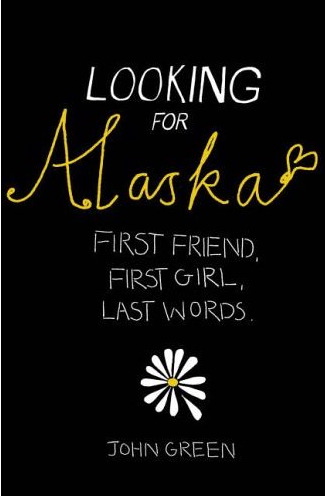
Review: Looking For Alaska, by John Green

"Sixteen-year-old Miles Halter's adolescence has been one long nonevent - no challenge, no girls, no mischief, and no real friends. Seeking what Rabelais called the "Great Perhaps," he leaves Florida for a boarding school in Birmingham, AL. His roommate, Chip, is a dirt-poor genius scholarship student with a Napoleon complex who lives to one-up the school's rich preppies. Chip's best friend is Alaska Young, with whom Miles and every other male in her orbit falls instantly in love. She is literate, articulate, and beautiful, and she exhibits a reckless combination of adventurous and self-destructive behavior."
-amazon.com product page (WARNING: The rest of the amazon.com description contains crazy spoilers, so avoid it!)

I love books set in boarding schools. From Harry Potter to John Marsden’s very excellent and funny ‘Gatsby,’ if you stick a bunch of students in a building together I’m pretty damn happy.
I think its because having so many people living together creates so many opportunities for mischief and drama, and also because I find the student/teacher relationship a hundred times more interesting than the teenager/parent one.
So considering that I had already read and loved Paper Towns (review forthcoming, eventually), and that it was set at a boarding school, I was pretty much sure that I would like John Green’s Looking for Alaska.
Which should have guaranteed that I wouldn’t like it, or at least that I would be a little disappointed by it. But sometimes the universe forgets to be contrary and you’ll start a book expecting to really like it and, against all odds, you’ll actually end up really liking it.
The plot is simple; Miles, who likes to read biographies and memorise people's last words, convinces his parents to let him to boarding school where he hopes to find a fuller life.
Now maybe it’s me, but does that sound boring or what? It’s probably because summaries of books I usually read include words like “superhero” or “apocalyptic” or “blood thirsty ninja-pirate-zombie-robots.” If I were to encounter an adult mainstream book that that plot I’d consider re-reading Twilight before I’d touch it, but YA books, especially YA books by John Green, have a secret weapon that makes up for the lack of ninja-pirate-zombie-robots (from Mars!): the characters.
A well written young adult character is worth twenty well written adult characters, in my book. And a young adult character written by John Green? Worth another twenty again.
Take Miles. The kid is endearingly pretentious. He reads biographies of famous poets but thinks poems are boring, he dismisses the kids in his Florida home town and goes all the way Alabama in search of some new ones. (Is Alabama very from Florida? My knowledge of how the USA is laid out is being not so much…) He gets all bent out of shape when his new roommate doesn’t immediately offer to take him under wing, and yet, for all that he’s pretty damn likable.
The supporting characters are just as real and engaging, and you get the feeling that John Green could have written a book from any of their point of views and it would have been a damn good book.
The only character I had a tiny issue with was Alaska herself, and that’s only because I’ve also read Paper Towns and she seemed remarkably similar to that book’s Margo Roth Speigleman. The way both girls act, their flaws and personality quirks all line up. Even the way Miles would obsess over and describe Alaska echoed the descriptions from Paper Towns. (Or the other way around rather, as Looking For Alaska was published first). I’ll have to read more books by John Green before I form an opinion, but I do hope he has more than one kind of hyperactive, quirky female character in his repertoire.
The thing I liked most about this book was the skillfull way Green builds up a sense of dread. The most obvious way he does this is by breaking the book down into bite sized sections, each one titled ‘x hours before.’ My reaction: X hours before what? X HOURS BEFORE WHAT? Something good? X hours before puppies and milk and sunshine? Hope for puppies and milk and sunshine all you want, but there’s more than enough clues to hint that that something unpleasant is coming.
And the characters are just completely clueless, because obviously they can’t see the ’40 hours before’ hanging over their heads like we can.
And eventually we hit 0 hours before, and the book shifts to ‘x hours after’ and while this isn’t as easy and light to read as the before section of the book, I think the After section was a richer and more fulfilling experience. Really the before and after parts of the novel read like two different books, but at the same time the book needs both of them. The after would not have been as powerful without the before, and before would have seemed too shallow and easy without the weight of the after.
Wow, it’s really hard to talk about this book without spoiling things. So I’ll leave it here with a final urge for you to go out and buy this book, or any book by John Green. I’ll even recommend the ones I haven’t read yet, completely confident I am of their awesomeness.
How did I get this book: my boyfriend bought it for me 


Review: The Scar, by China Mieville

"The Scar begins with MiĆ©ville's frantic heroine, Bellis Coldwine, fleeing her beloved New Crobuzon in the peripheral wake of events relayed in Perdidio Street Station. But her voyage to the colony of Nova Esperium is cut short when she is shanghaied and stranded on Armada, a legendary floating pirate city. Bellis becomes the reader's unbelieving eyes as she reluctantly learns to live on the gargantuan flotilla of stolen ships populated by a rabble of pirates, mercenaries, and press-ganged refugees. Meanwhile, Armada and Bellis's future is skippered by the "Lovers," an enigmatic couple whose mirror-image scarring belies the twisted depth of their passion. To give up any more of MiĆ©ville’s masterful plot here would only ruin the voyage through dangerous straits, political uprisings, watery nightmares, mutinous revenge, monstrous power plays, and grand aspirations."
-amazon.com product page


I bought one of Mieville’s earlier books, Perdido Street Station, for two reasons: 1) The cover appealed to me, and 2) it was very thick. I was a poor uni student at the time you see, with a very limited book buying budget, so doorstoppers represented much better value.

By the end of the day I’d learned two things about the book: The nice smelling German backpacker who was getting off the train as I got on was a big fan (‘China Meiville! Very cool!’ He exclaimed as he passed me), and 2) the first chapter featured a graphic sex scene between a man and a lady insect. (The English language doesn’t really have a word for the peculiar sensation of reading about flushed bug genitalia on a train surrounded by strangers.)
What can one say about Perdido Street Station? You’ll love it or you’ll hate or, more likely, you’ll love and hate it at exactly the same time. And what more can an author hope for than that?

I found Perdido Street Station to be such an intense and overwhelming read that it put me off China Mevielle a little. Not in a bad way, it was more like when you eat a bar of super dark chocolate and have to go a few days before you can eat some more. Except just replace days with years, because that’s how long it took me to find the strength to return to Mieville’s world of Bas Lag.

I was expecting the Scar to be as draining and awesome and frustrating as Perdido. Original settings wasted on a meandering plot, quirky characters getting a little lost amongst all the chaos, clear and sharp scenes book ended by lengthy blocks of confusing prose. But it seemed, to me at least, that the Scar displayed all that I loved about Perdido Street Station, and discarded all that I didn’t.

Or, to put in another way: I loved every single thing about this book. Seriously. While devouring it I would often set it down, get up from my cosy reading nest in front of the fireplace, find my boyfriend and shout ‘how can this book just keep getting better?’ It’s like it defied some law of literary physics, the way the Scar would just keep ramping up the awesome.

Floating cities and pirates and sea monsters and vampires (vampires!) and mutiny and, and, and, argh! How can one book contain so much awesome? It seems like every time you turn a page in the scar there are ideas that other authors would gladly devote entire works to exploring, but for Mieville it’s all just part of the background. Which is what makes the world of Bas Lag so dense and fun to explore and believable. Yes, believable. A race of mosquito like beings who live in exile because their women folk once took over the world? Believable. A distant land where the upper echelons are undead? Believable. A scar in the sky through which the Gods entered the world eons ago? Believable! And don't even get me started on Uther's crazy ass possibility sword....

The cast is populated with good people doing bad things and bad people doing good things, and you fall in love with some of them despite the awful things they have done, and you feel desperately bad for some them again in spite of the awful things they have done at the end you realise that there is not one character in the book who is wholly without blame for the all the catastrophic bad stuff that goes down. And frankly, I wouldn’t have it any other way.

There are plots and sub plots and sub sub plots and yet the book never feels crowded, and when the book ends there were no loose ends. Consider that for a moment. The Scar features a huge cast, with scads of POV characters, and every single one of them has their own story arc and at the conclusion of the book every one of those arcs has come to a satisfactory (which is not to say happy, no sir) conclusion. It all ends so perfectly that I don’t feel the slightest desire for a sequel. It all ended so perfectly that I actually find the idea of a sequel to be vaguely repulsive.

I’m aware that there are people out there who did not love this book as unreservedly as I did, so if you want to know if this book has any flaws possible you should ask them. In my eyes, the Scar is perfect. (It almost makes me want to reread Perdido Street Station…)

How did I procure this book? It was gift from my enabler (read: boyfriend)


Tuesday, July 20, 2010

Review: The Thief, by Megan Whalen Turner

"Things are not what they seem in this story of wit, adventure, and philosophy. Gen, an accomplished thief incarcerated for stealing the king's seal, is dragged from his cell by the king's magus, who is on a quest. The prize is Hamiathes's Gift, said to be a creation of the gods that confers the right of rule on the wearer. During the quest, the magus and Gen take turns telling the youngest member of their party myths about the Eddisian god of thieves"
-amazon.com product page

So you know how in cartoons when a character needs to portray an air of innocence they slump their shoulders, shove their hands in their pockets and whistle?

Megan Whalen Turner’s ‘The Thief’ is pretty much the literary equivalent of the innocent whistle. It devotes great effort to convincing the reader that Gen, the titular thief, isn’t up to anything, and in the end is about as convincing as whistling cartoon character.

Any magician will tell you if you don’t want the audience to see what you’re doing, then give them something else to look at. Turner doesn’t do this, she just hides away Gen’s true plans and motivations which, considering this is a first person novel, doesn’t leave the reader with much to see inside of Gen’s head. He complains of being tired and hungry a lot, and he spends a lot of time describing the other characters and their interactions, but… that’s about it.

He makes no effort to escape or to change his situation, simply passively going along with what his captors tell him to do and passivity is rarely an interesting trait in a protagonist. And yes people who have finished the book are going to say, ‘but, but, Megan! (er, Megan as in me, not Megan as in the author...) Gen had a plan all along!’ To which I reply that that’s no excuse. Look at the Artemis Fowl books, for example. They’re aimed at a younger audience than this one, so that removes any silly age argument, and one of the coolest things about them is that the reader rarely knows what Artemis is really up to until the final reveal. Half the time the reader doesn’t even know he is up to something. Artemis Fowl is a world champion poker player next to The Thief's innocent whistle.

Another thing I like about the Artemis Fowl books (I’m a big fan, can you tell) is that Artemis is a genius and we actually get to see evidence of him being all smug and geniusy. Gen is supposedly a super awesome thief, and yet we see no evidence of his skills. Yes we see the results, occasionally throughout the book Gen will mention an object he apparently stole a few pages earlier but we never actually see him steal anything. Imagine if every time a character got into a tight spot the writer simply skipped the part where they got out of it? Or if Sherlock Holmes just announced that he knew who the bad guy was without ever explaining how he figured it out? How are we, the reader, supposed to believe in Gen’s skills when we never actually see them in play?

So not only are most of Gen’s thoughts hidden away, we never see any evidence of his supposedly awesome skills. Couple this with the fact that for much of the book nothing happens, and you can see why a reader might get a little frustrated. There’s only so many campfire stories and descriptions of olive trees that a girl can take!

Now you might think from all this negativity that I didn’t much like this book at all. But honestly, despite its flaws, it was a pretty fun and easy read. There were some pretty clever turns of phrase scattered throughout, and once things actually started to happen (nearly three quarters of the way in, mind you) things picked up dramatically.

I might eventually pick up the next books in this series, but I’m not in any huge hurry to do so.

How did I come into possession of this book? I bought it