Showing posts with label Books I loved. Show all posts

Monday, October 31, 2011

Review: The Cold Commands, by Richard Morgan


This review contains spoilers for The Steel Remains

Is it weird that my favourite character in this book was Ringil’s longsword, Ravensfriend? That’s right folks. No longer merely content with crafting some of the coolest human(ish) characters around, Richard Morgan is now imbuing inanimate objects with more personality than your average fantasy author could dream of.

But of course, there’s a lot more to The Cold Commands than just scene stealing weaponry. When last we left them it seemed that Ringil, Archeth and Egar would heading south together to Archeth's house, and given how fun it is to watch the three play off each other I was looking forward to seeing them share page space. So I was a little disappointed when the book opened, much as the first one did, with the three friends involved in three separate story lines. But come on, there’s only so long disappointment can last in the face of Richard Morgan’s awesome prose and clever dialogue.

By the time I hit the midway point my initial feelings of disappointment were a distant memory, and I was enjoying The Cold Commands even more than I did The Steel Remains. (And I really liked The Steel Remains). I spoke in my review of The Steel Remains of how well Morgan handles backstory, and here he continues to show his prowess in that area. The war with the scaled folk is fleshed out further, but it’s done very organically without the use of clunky flashbacks and the like. We also get a few tantalizing glimpses into the battle that earned Egar the title of Dragonbane.

And can I just stop here and say what a fantastic example of characterization the whole Dragonbane thing is. Because Egar and Ringil both killed that dragon, but only Egar is known by ‘Dragonbane’ title that killing a dragon gets you. Ringil, perverted degenerate and corrupter of youth that he is (can you feel my sarcasm from over there?), is conveniently left out of the tale. Where a lesser author would make a huge deal out of it Morgan doesn’t, and it’s very effective. You can tell a reader that your hero is an outcast for x reason until you’re blue in the face, but it doesn’t mean squat unless you show it too.

I think the main reason I enjoyed this book more than its predecessor is a simple one. Whereas Ringil spent much of The Steel Remains wandering around the grey places with Seethlaw, understandably way out of his element, here he spends the bulk of the novel in the “real world.” Watching Ringil (and Ravensfriend) interact with Morgan’s well developed cast was a real pleasure. Really, I can’t overstate how much fun I had watching Ringil charm, intimidate and terrify everyone around him in turns. (I did miss Seethlaw though…) His interactions with the Emporer (who remains one of my favourite non-sword shaped characters, if only for how impressive I find the way Morgan uses him to play with our expectations) was a particular treat.

I will say the plot is very much the plot of a middle book. Whereas the Steel Remains can and does stand very well on its own, The Cold Commands is clearly setting up the events of the trilogy’s final volume. Which didn’t bother me, but it might others. Plot elements introduced in books one, namely the whole “dark lord” business are also further explored here. When it comes to subverting fantasy conventions Abercrombie has nothing on Morgan in my opinion, and I’m very interested to see where this dark lord thing leads. It’s like a wicked inversion of the “chosen hero” trope, and I’m getting a real kick out of it. I also think the subversion is entirely intentional on Morgan’s part. Ringil’s reaction when that creepy crossroads dude (which, wow, what an awesome scene) calls him a farmboy was priceless, but also telling.

So, incase it’s somehow unclear, I loved this book. I really can’t see anyone who enjoyed The Steel Remains not getting, at the least, the same level of enjoyment out of The Cold Commands. I just can’t wait to see how Morgan brings this thing to a close. I’m also hoping to see a Ravensfriend spin off. What? It could happen…


I bought this book

Saturday, October 29, 2011

Review: House of Leaves, by Mark Z. Danielewski


Oh, House of Leaves. One of the few books to ever truly scare me. For months I slept with the lights on, and to this day I sometimes have to turn my bedside lamp on in the middle of the night just to make sure my walls are still there. I refer to this book often enough, I figured I should actually attempt a review of it.

Let me first try and describe what the book is about, but bare with me here because shit gets complicated. We start with Johnny Truant, an aimless young man living a life of drugs and loose woman in L.A. Mr. Truant is a touch fond of purple prose, but you can make it through that you'll fine he is a fascinating character. He appears at first to be a bit of a loser, but as his narrative progresses you realise that he’s actually very intelligent. It’s not obvious (trust me, nothing in this book is obvious), but it adds some fascinating layers to how Johnny comes across.

The book opens with Johnny’s friend Lude calling him in the middle of the night. An old guy in Lude's apartment complex has died, does Johnny want to come and go through his stuff? In the old man’s apartment Johnny discovers a rambling behemoth of a manuscript entitled ‘The Navidson Record.’ ‘The Navidson Record’ is basically an extended academic analysis of a series of films by award winning photographer Will Navidson. Except, as Johnny tells us, neither Will Navidson nor the films the paper discusses actually exist.

You still with me? The bulk of House of Leaves is basically ‘The Navidson Record.’ (Or rather, Johnny’s transcription of it, and if you thought unreliable narrators are bad try unreliable transcribers…) Will Navidson and his partner Karen Green move with their two children to the countryside to make a fresh start. Things go swimmingly at first, until they go away one weekend and come home to find a closet has appeared in their house. Then they realise their house is slightly, just slightly, bigger on the inside. Then a hallway appears, one that’s deeper than should be physically possible. Then an entire buttfuck insane labyrinth appears and the house itself starts to turn on its residents.

The Navidson Record is interspersed with extended footnotes from Johnny, and we see that as things get worse for Navidson, Johnny’s grip on reality is slipping.

I always preferred The Navidson Record to Johnny’s parts of the book. The way it was written really appealed to me, and I’ve never come across another book that does the same thing. The closest thing to it would be all those “found footage” movies. The Navidson Record is describing what happens in the footage Will Navidson filmed of his house going nuts. We never get to see inside the character's heads, but we do get the narrators thoughts on what might be inside their heads. It sounds like it would cause a disconnect between the readers and the characters, but I didn't find it to be so. And you know how I am with characters. Because it’s written in a faux academic style the narrator also examines the symbolism of certain shots, or he references books other people have written about Will Navidson (all made up). It might be because of my academic background, but I dug the hell out of this approach.

Danielewki hands the reader nothing. The book is littered with clues and riddles, but you have to find them yourself. There’s one scene in which a terrified Johnny blurts out some gibberish, which I dismissed as gibberish, but which I later learned was a latin phrase written out phonetically. There’s another section where the first letter of every line spells out a new sentence, or there’s the fact that every instance of the word house appears in blue, and every mention of the mythical minotaur has been struck through. And this is just the tip of the iceberg. This might seem a little gimmicky, but it works in the context of the book. Johnny is slowly going mad (because of the Navidson Record? Or is he just following in his mother’s footsteps? Speaking of his mother, what’s her connection to the old man who wrote the Navidson record? The mysteries in this book will quickly spiral out of control if you let them…) and his mounting paranoia is reflected in his desire to “hide” the truth.

There are those who say that House of Leaves is postmodern for the sake of being postmodern, and all style with no substance. I disagree. Underneath all the crazy typography is a real story of love, family and trust. Especially trust. Strip away all the crazy formatting and you'd still have a pretty amazing story waiting for you. And maybe a few sleepless nights.


This book I found in a dead guy's apartment. Or bought.

Friday, September 16, 2011

Review: Under The Poppy, by Kathe Koja


Love: it’s a triangle. War: is coming. Betrayal: is inevitable. Sex: watch out for the naughty puppets. -amazon.com product description

How did I even end up with this book? Do you know what it’s about? Puppets. Puppets! Fucking puppets man. I hate puppets. The creep me the hell out. And ‘Under the Poppy’ is just crammed full of them. In the literal sense, in that there is traveling genius puppeteer Istvan who has created and stolen a whole troupe of puppets with which he performs well received (and oft times risqué) shows all across 1800s Europe. But also in the metaphorical sense, in that Koja spends a lot of time examining who controls a mans strings, and what lengths one must go to cut them.

And it’s not just the puppets. This book? Is literary fiction. Do you see me reading literary fiction? No. I read about space ships and swords and post apocalyptic landscapes. And this book? Has none of those things. There’s nothing speculative at all, it’s not like, say, ‘The Book Thief’ where on the one hand it’s all literary but on the other hand it’s narrated by death, no, everything in ‘Under the Poppy’ is as it seems. (Except for Istvan’s creepy ass fucking puppets).

Again I ask, how did I end up with this puppet filled tome of magic-less literature? Actually, no, that’s not the right question. The right question how, given the abundance of puppets and lack of dragons, did I come to love this book so much? Because guys, seriously, I loved this book.

It barely even has a plot for crying out loud! Well, no, actually I think it does have a plot, I think it’s just that I wasn’t quite smart enough to follow it. Or maybe I was too distracted by the decadent prose to keep track of it? Ok, so, we’re in a brothel in the year eighteen something or other, somewhere in Europe, and there’s some sort of war going on. Rupert and Decca are the powners of said brothel, and it’s all business as usual until Decca’s brother Istvan (and his puppets) show up out of the blue. It turns out Dia is in love with Rupert, but Rupert loves Istvan, and Istvan loves Rupert too except that they’ve been parted for reasons most mysterious… Also they need to figure out a way to keep the brothel safe from the encroaching war.

At any given point in this book I was never entirely sure what was going in. There were a great many political machinations, and there a were a bunch of flashbacks to Rupert, Decca and Istvan’s childhoods as Oliver Twist-esque street urchins and then, just when I thought maybe I was getting the hang of it, the first half ends and the second half is basically a sequel set years in the future. Actually this second half was a lot easier for me to follow, and I don’t know if was written to be so, or if I was just settling into the unique grove of Koja’s prose.

In any case, it never really mattered to me that I was always a little lost. This book reminded me of a modernist painting, wherein the artist suggests what the subject is without ever actually coming out and painting. Koja hands nothing to the reader. She revels in the details, the smells and sounds of her European setting, and it’s from this that our understanding of what’s going on is formed. Each sentence is like a rich desert, layered and beautiful, and I don’t think I’ve ever enjoyed a book so much on a purely mechanical level.

The theme of masters and puppets is always at play in the book, although never obtrusively. I found that I didn’t notice it so much as I was reading, but after I was done I find myself thinking about what Koja was saying a lot. Who is the master of who, indeed.

Really there is nothing I didn’t love about this book. The ending was perfect and bittersweet, the characters to a one were exquisitely crafted, and the dialogue was a delight to read. It had that witty nature to it that only books set in bygone centuries seem to be able to get away with, like a well crafted dance that we’ve forgotten the steps to. Plus, Istvan and Rupert! Talk about your epic romance. Seriously.

What else can I say, but don’t let the disturbing puppets keep you from this truly amazing book.


This book: I bought

Friday, September 9, 2011

Review: A Rope Of Thorns, by Gemma Files


One of the most unique reading experiences for me in a long time was Gemma Files' "Book of Tongues." (I recommend reading that one before reading this review.) The book was not without its flaws, but I'd take flawed and interesting over perfect and safe any day of the week, believe me.

Not surprising then that I dived straight into its sequel, and book two of Hexslinger trilogy, "Rope of Thorns" as soon as it arrived at my doorstep. As always with a sequel I began with a small amount of trepidition. Would this book be as good as the first one? All too often it seems that the answer to that question turns out to be no. But not this time my friends. Not this time!

I loved "Rope of Thorns." It was everything "Book of Tongues" didn't quite manage to be, and all of the faults (all of them!) that I found with the Hexslinger Trilogy's first book had been addressed.

Despite having a lot less narrator time this go around, the character of Ed Morrow finally became real to me. There's a genuine goodness in Ed that's lacking from the other men in these books, but for all that he's just as capable as Chess or Rook as committing acts of great violence. It was a contrast I found fascinating.

Instead of Ed most of this book was told from the point of view of Mister Chess Partager himself. I didn't reread "Book of Tongues" before starting this one (way too eager!) but I'm fairly sure there wasn't any Chess point of views in it. He's an enigmatic figure in many ways, and when I realised I was seeing things through his eyes I was concerned that it would "ruin" the mystery of him. Not so! If anything the greater insight into the workings of Chess's, uh, shall we say unique? mind only made him more interesting to me. And more sympathetic, by a mile!

Ah, poor Chess. Rook's monstrous betrayal has changed him, that's for sure. And you have to feel for the guy. There's one scene where he has to stay in disguise while a song is sung about how every bad thing Rook ever did is pretty much all Chess' fault, and I don't remember the last time I felt so keenly for a character. I kept oscilating between wanting Chess and Rook to somehow work things out, and and wanting Chess to just blow Rook's smug head clean off. Or maybe some combination of both?

We have some new characters this time around, the most noteworthy of this being Experiance "Yancy" Kloves, who neatly takes care of complaints that these books lack women. Yancy is a capable, practical young woman, but she manages to be so while staying true to the time period, in my opinion. There was a dry humour to her point of view that really appealed to me, and I enjoyed watching Chess try and figure out exactly what to do with her.

Personally my biggest issue with "Book of Tongues" was that the plot tended to jump around a bit haphazardly. But in "Rope of Thorns" things are pretty much linear. There's an interlude set in Rook's newly founded Hex city (very interesting. It was satisfying watching him realise the enormity of his mistakes, and I'll be very interested to see how things in Hex City play out in the next book) but other than that we stick with Chess and his entourage, without even any flashbacks.

Really "Rope of Thorns" is everything you hope for in a sequel, but so rarely get. The plot is advanced, a greater understanding of characters is granted, new and interesting characters are introduced. Files' prose remains a delight to read, the cadence of her sentences captures the wild west setting perfectly, and the images she paints are a fascinating mix of frontier practicality and magic bred surrealism.

Role on "Tree of Bones."

This book: I purchased

Thursday, April 21, 2011

Review: The Steel Remains by Richard Morgan


An alternate title for this book would be: Back Story: How to do it right! Somewhat less catchy than The Steel Remains, to be sure. But very, very true. I can’t think of any other books that fills in the back story of it’s characters as seamlessly as this one does. And guys, there’s a lot of back story.

The book is set a decade or so after a huge war, in which previously antagonistic nations had to band together to best an external threat. The narrative follows three hero’s of this war, Ringil, Archeth, and Egar as they each undergo their own little narrative quests which eventually merge into one big one. Ringil must return home, where he is a barely tolerated disgrace (because he’s a *gasp* homosexual!) and try to track down a cousin sold into slavery. Arceth is trying to learn how to work with a new emperor, and is trying to understand her own past. And Egar is struggling to feel content in his role as clan chief, while meanwhile his own brother’s plot to overthrow him.

It’s the kind of book where the back story is integral, where what happened before the story commences is just as important as what’s happening now. Think the first rise of Voldemort in the Harry Potter books, or the overthrow of House Targaryen in A Song of Ice and Fire. However, unlike those two examples, The Steel Remains is a relatively slim book. (Especially when you consider that it’s the first part of a fantasy trilogy… )And yet I have no trouble envisioning the war we never actually see, as though Morgan had spent chapters and chapters re-telling it, (which he does not).

The key, I think, is that Morgan assumes his reader possesses an ounce of intelligence. Such a simple thing, and yet so few authors really get it. You don’t have to spell things out. I know you want to make doubly sure that the reader understands this crucial bit of information, but guys, guys, seriously, you have to trust us! We’ll get it, and we’ll even thank you for making us figure it out ourselves. Isn’t it better to assume that smart people would want to read your book, instead of ones that need their hands held every step of the way?

Consider the three main characters of The Steel Remains, who I have already briefly mentioned. At no point does Morgan come out and say that they’re friends, or that they even know each other, and for much of the book none of their scenes overlap. But we slowly come to realise that all three fought in the war. Egar might briefly recall something that Ringil once said, or Ringil might have cause to think of Archeth, and their thoughts have such a perfect mix of affection and affectionate insult that only true friends can understand, that the reader knows these guys were close. It’s perfectly done, truly perfect.

When you finish this book it feels like you’ve been reading about these characters for twelve epic volumes, so well do you feel you know them. (I wish I could read about them for twelve epic volumes, because they’re a fascinating and entertaining bunch.) When the three are finally reunited it's as emotionally satisfying as if you'd been waiting for that moment to happen for years, instead of just a few hundred pages.

The minor characters are also excellently done. I want to draw particular attention to the Emperor. When first he is introduced I pretty much wrote him off. He's the spoiled son new to the throne, which had been held for many years by his wise father. He's selfish and mean and a terrible, terrible, ruler. Except, uh, maybe he's not? Rarely am I as surprised by a character as I was by this guy. Props to Morgan, for realz.

Morgan’s writing is an excellent mix of humour and darkness. But I don’t want to draw Abercrombie comparisons because it seems like every time a darker fantasy comes along now his name gets dropped. And anyway, I find Morgan’s characters to be real in a way that Abercrombie’s are not, less bleak for bleaks sake perhaps.

It will, I suspect, be a long wait for October and the continuation to this awesome trilogy.

This book: I bought

Saturday, September 4, 2010

Review: Throne of Jade, by Naomi Novik


Did I enjoy Throne of Jade as much as its predecessor, Temeraire? If anything, I enjoyed it more. I loved it so much that yesterday I made my ever patient boyfriend drive me to a city nearly two hours away so I could purchase the next two books for twice the price than if I got them from Book Depository, because I want to read them right now, not in 7-15 days!
Reviews of those two will be forthcoming, I'm sure, but for now let's talk Throne of Jade. (Probably you should read Temeraire before you read this). The plot is basically this: China wants Temeraire back, preferably sans Laurence. So it's off to China with Laurence and Temeraire, where they hope to convince the emperor to let Britain keep Temeraire.
Let me first point out a two ways in which I think this book could have easily faltered. First, the depiction of the Chinese and their culture was of course going to be tricky, especially considering that our POV man, Laurence, it not favourably disposed to the Chinese AT ALL. (The are trying to remove him from Temeraire's company, after all). But Novik does a good job of contrasting China to Britain and highlighting how strange everything is to the Western characters without ever sinking into, 'gosh, look how silly these Chinese people are!' Some of the Chinese characters are portrayed negatively, but its never because they are Chinese. The insertion of Dragons into Chinese culture also felt very authentic, and far more natural than the British dragons in book one.
The second trap that I am glad Novik avoided is a common trope in books like this. Almost every character in this book is devoted to separating Laurence and Temeraire. How easy it would have been, and how predictable, to have a miss-communication or misunderstanding that does indeed separate the two, until they triumphantly overcome the obstacle. Yawn yawn yawn. The relationship between Temeraire and Laurence in this book is deeper than that trope (which I hate, without exception). There is a moment where it could have come into play; Temeraire is inexplicably absent when Laurence desperately needs him. But, but, wait for it, Laurence gives Temeraire a chance to explain and, oh my god, get this, Temeraire explains! Wow!
It was very gratifying to see Laurence and Temeraire's relationship develop. In the first book there was definitely a feeling that Temeraire was a child and Laurence an adult, but as Throne of Jade plays out we see the two slowly become equals. Temeraire starts to establish who he is outside of Laurence and, instead of seeing this as some kind of abandonment, Laurence is supportive. What I'm saying is that one of the most realistic and healthy adult relationships I have ever encountered in fiction is here, between a man and his dragon.
The plot, while I may have made it sound simple, is very exciting. Storms, sea serpents and murder attempts abound, and unlike in the previous book there is quite a few character deaths. There was also a fight between two dragons, which played out very differently to the multi dragon battles we’ve already seen and was a thrill to read.
Ultimately I felt that this book nimbly sidestepped the potential pitfalls that faced it, and has left even more eager to continue reading the adventures of Laurence and Temeraire.


How did I get this book? From book depository 


Saturday, July 24, 2010

Review: The Scar, by China Mieville

"The Scar begins with Miéville's frantic heroine, Bellis Coldwine, fleeing her beloved New Crobuzon in the peripheral wake of events relayed in Perdidio Street Station. But her voyage to the colony of Nova Esperium is cut short when she is shanghaied and stranded on Armada, a legendary floating pirate city. Bellis becomes the reader's unbelieving eyes as she reluctantly learns to live on the gargantuan flotilla of stolen ships populated by a rabble of pirates, mercenaries, and press-ganged refugees. Meanwhile, Armada and Bellis's future is skippered by the "Lovers," an enigmatic couple whose mirror-image scarring belies the twisted depth of their passion. To give up any more of Miéville’s masterful plot here would only ruin the voyage through dangerous straits, political uprisings, watery nightmares, mutinous revenge, monstrous power plays, and grand aspirations."
-amazon.com product page


I bought one of Mieville’s earlier books, Perdido Street Station, for two reasons: 1) The cover appealed to me, and 2) it was very thick. I was a poor uni student at the time you see, with a very limited book buying budget, so doorstoppers represented much better value.

By the end of the day I’d learned two things about the book: The nice smelling German backpacker who was getting off the train as I got on was a big fan (‘China Meiville! Very cool!’ He exclaimed as he passed me), and 2) the first chapter featured a graphic sex scene between a man and a lady insect. (The English language doesn’t really have a word for the peculiar sensation of reading about flushed bug genitalia on a train surrounded by strangers.)
What can one say about Perdido Street Station? You’ll love it or you’ll hate or, more likely, you’ll love and hate it at exactly the same time. And what more can an author hope for than that?

I found Perdido Street Station to be such an intense and overwhelming read that it put me off China Mevielle a little. Not in a bad way, it was more like when you eat a bar of super dark chocolate and have to go a few days before you can eat some more. Except just replace days with years, because that’s how long it took me to find the strength to return to Mieville’s world of Bas Lag.

I was expecting the Scar to be as draining and awesome and frustrating as Perdido. Original settings wasted on a meandering plot, quirky characters getting a little lost amongst all the chaos, clear and sharp scenes book ended by lengthy blocks of confusing prose. But it seemed, to me at least, that the Scar displayed all that I loved about Perdido Street Station, and discarded all that I didn’t.

Or, to put in another way: I loved every single thing about this book. Seriously. While devouring it I would often set it down, get up from my cosy reading nest in front of the fireplace, find my boyfriend and shout ‘how can this book just keep getting better?’ It’s like it defied some law of literary physics, the way the Scar would just keep ramping up the awesome.

Floating cities and pirates and sea monsters and vampires (vampires!) and mutiny and, and, and, argh! How can one book contain so much awesome? It seems like every time you turn a page in the scar there are ideas that other authors would gladly devote entire works to exploring, but for Mieville it’s all just part of the background. Which is what makes the world of Bas Lag so dense and fun to explore and believable. Yes, believable. A race of mosquito like beings who live in exile because their women folk once took over the world? Believable. A distant land where the upper echelons are undead? Believable. A scar in the sky through which the Gods entered the world eons ago? Believable! And don't even get me started on Uther's crazy ass possibility sword....

The cast is populated with good people doing bad things and bad people doing good things, and you fall in love with some of them despite the awful things they have done, and you feel desperately bad for some them again in spite of the awful things they have done at the end you realise that there is not one character in the book who is wholly without blame for the all the catastrophic bad stuff that goes down. And frankly, I wouldn’t have it any other way.

There are plots and sub plots and sub sub plots and yet the book never feels crowded, and when the book ends there were no loose ends. Consider that for a moment. The Scar features a huge cast, with scads of POV characters, and every single one of them has their own story arc and at the conclusion of the book every one of those arcs has come to a satisfactory (which is not to say happy, no sir) conclusion. It all ends so perfectly that I don’t feel the slightest desire for a sequel. It all ended so perfectly that I actually find the idea of a sequel to be vaguely repulsive.

I’m aware that there are people out there who did not love this book as unreservedly as I did, so if you want to know if this book has any flaws possible you should ask them. In my eyes, the Scar is perfect. (It almost makes me want to reread Perdido Street Station…)

How did I procure this book? It was gift from my enabler (read: boyfriend)


Saturday, July 17, 2010

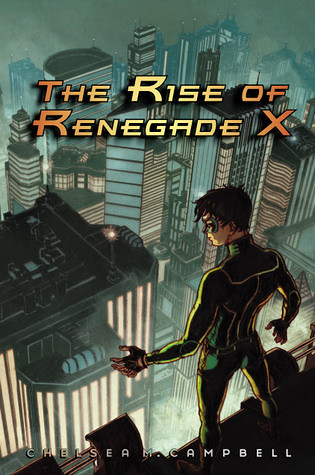
Review: The Rise Of Renegade X, by Chelsea M. Campbell


"Damien Locke lives in an alternate universe inhabited by superheroes, supervillains, and regular people. If you are a hero, a letter H appears on your thumb when you turn 16. If you are a villain, you get a V. On his 16th birthday, Damien gets an X. He is half hero, half villain, the product of a one-night stand between his mad-scientist supervillain mother and superhero father Crimson Flash..."
-from the Amazon.com product page  

There is nothing, and I mean nothing, that I won’t forgive a book for if it gives me fantastic characters. Plot holes? Cliches? Incest? Like the annoying girl you tolerate because her brother is way hot, I’ll welcome all those flaws it the characters are bitching.
 
And boy are Chelsea M. Campbells characters bitching!

Which is not to say that the book is full of plot holes and clichés. Incest on the other hand… No, I kid. (Although, Damien does spend an unusual amount of time dwelling on this mother’s sex life…) There is little that is clichéd about Renegade X’s plot, which surprised me. Oftentimes in books like this, which is to say books that feature superheros (and villains!) of the author’s own creation, certain characters will mirror other, more well known comic superheros. Perry Moore’s excellent “Hero” for example is peppered full of awfully familiar superheros, including one from another planet whose only weakness is a certain kind of crystal…
There is none of this with Campbell’s superheros. It’s surprising how refreshingly original they are. Even when their abilities are not so unique, such as shape shifting or flying, Campbell avoids comparison with “real” superheros completely.

And there are no major plot holes, or at least none that immediately jump out me. Well, no, that’s not true. I did wonder why, if every villain is clearly identifiable by the V on their thumb, were they not all just thrown in prison? Or at the very least why were they allowed to have a school where torture and mayhem were on the curriculum? (Nothing in the text suggested that Villmore’s purpose was a secret to the general public). The world building, perhaps, is a little scarce, but Campbell outlines the “rules” of her universe clearly enough and then sticks to them.

But these faults are niggley and, as I said, the characters! Oh man, the characters make up for everything! She could name her heroes Superguy and Wonder Lady and have more plot holes than Twilight and I would still be here raving about this book.

Damien, in particular, is excellently written. There is much to be said in favour of characters who are always quick with the right comeback, who say the things that we would never dare to. This type of character is common in speculative fiction, think your Loche Lamoras and Kvothes, and Damien has this element in spades (his snarky sense of humour had me laughing out loud more than once, and I’m normally a very quite reader). But unlike the other dashing anti-heroes I’ve mentioned, Damien would also fit in very nicely in a mainstream YA novel. Something witty by John Green or David Levithan.

This is because, despite his super powers, Damien is a kid a kid with a set of problems that any coming of age novel would be happy to have. He’s meeting his Dad for the first time, he’s worried that his Mum has less time for him now she has a new boyfriend, he still has feelings for his ex and on top of it all he has to decide if he wants to devote the rest of his life to good or evil. Well, ok, maybe that last one is not so common…

The rest of the cast is just as well fleshed out as Damien, with all of them from main to minor, expertly toeing the line between realistic and comic book over the topness.

Fans of good old fashioned YA coming of age tales, and fans of comic books, and especially fans of both will find much to love here.

How did this book get into my hot little hands? It was gift from my enabler (read: boyfriend)