Wednesday, September 5, 2012
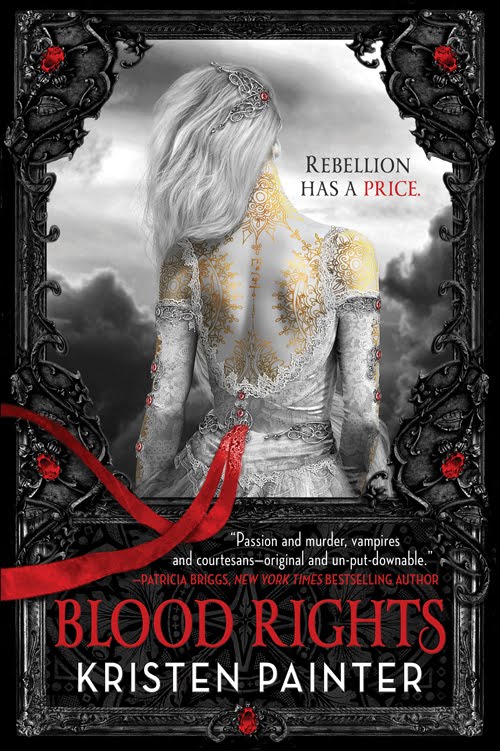
Review: Blood Rights, by Kristen Painter
Sunday, June 3, 2012
Review: The Hundred Thousand Kingdoms, by N. K. Jemisin
A
chapter into this book and I was rapt. I could see what all the hype was about
and I was kicking myself for waiting so long to start reading it. But somewhere
around the middle these positive feelings started to wane, and by the end I
found myself unimpressed. I don’t think I’ve ever had how I felt about a book
change so much while reading it!Wednesday, February 1, 2012
Review: Flesh and Fire, by Laura Anne Gilman
I firmly believe that nothing, nothing is more important in a book than the protagonist. A well written hero can carry the weakest of plots, elevate the plainest of supporting cast and make an otherwise average book into something special. Laura Anne Gilman’s ‘Flesh and Fire’ proves all to well that the reverse is definitely not true.
The concept of Flesh and Fire is really cool, and handled originally. A few select men, called Vinearts, can coax magic from grapes and craft potent spell wines. Once they used their exclusive magic to gain power, but now there are strict laws that stop Vinearts from being able to hold positions of power or influence.
Jerzy, a young slave, is found to have the abilities of vineart, and so is risen from his position to become an apprentice to the Vineart Master Malach.
There’s a lot to potentially like about this book. I’m not a fan of non-fiction, but having said that I really like it when a book teaches me things. When an author has clearly researched the topic of the book extensively and the knowledge just shines through. So it is with Flesh and Fire and wine making. I’m not saying that upon finishing the book you could go out and craft your own vintage, but I found the various minutiae of wine making that the book explores to be really interesting.
If only the protagonist, Jerzy, had been at least half as interesting. But sadly, he is not. There’s nothing to him. I mean, this kid has been a slave all of his life, until one day he gets yanked from the fields and becomes an apprentice to the man who owns him. A situation fraught with potential angst and conflict one would think. Jerzy never feels any kind of resentment towards Master Malach. His time as a slave was brutal and hard, and yet he never attempts to help his fellow slaves or even really thinks about them as being more as slaves. The explanation given for this is that the harshness of slavery is needed to make the abilities of a Vineart develop. Which I get, and should have made for some really fascinating dynamics between the once slave Vineart masters and the one slave apprentices. But it barely gets touched upon, and a large source of potential tension just goes to waste.
(And why are all the Vinearts men? The idea of a female Vineart is never broached, not even an offhand comment to explain why there are none. The silence on the matter bugged me more than a half ass excuse explaining it would have.)
I guess in a lot of ways Jerzy never stops being a placid slave. He does what he’s told and and he rarely moves the plot himself. The other characters act and react, think and plot and make decisions, Jerzy just lets the currents they create move him about. There’s only one scene I can think of where Jerzy uses his initiative and impacts the plot. That’s pretty unacceptable for a main character, in my opinion.
The secondary characters are much better done than Jerzy. The young trader Ao was a breath of fresh air, and I found his trader outlook to be really interesting. I also liked Mauhalt, a nobleman’s daughter who looks like she’s going to get a kick ass character arc normally reserved more male characters. (Which just bring me back to the question of female Vinearts, and the lack thereof).
Jerzy’s passivity might have been easier to take if not for the fact that this book feels like it’s all setup. Things don’t really get rolling until literally the last fifty pages or so, whereupon the book ends on a cliffhanger. I suspect the second book will be much better than the first. If nothing else the plot appears to have actually started, and in the final pages of the book I developed some slight hope that Jerzy was about to actually take charge.
Normally I wouldn’t even give the next book a try based on the serious flaws in this one, but Laura Anne Gilman is clearly a very capable writer and the series does have potential. If she turns Jerzy’s character around then his actions in the first boom will become the first part of an impressive character arc, and the ridiculously slow build of the plot would be forgivable. It still kinda sucks that you have to slog through a vaguely boring first volume to get to the good stuff.
I bought this book
Monday, January 9, 2012
Review: Vacation, by Matthew Costello

It's never a good sign when you sit down to review a book you finished only a few days ago and realise that you can’t actually remember any of the character’s names. In my head they’ve become ‘the cop dad’ or ‘the teenage daughter,’ which would tell me, if I didn’t already know, that the characters in 'Vacation' lack any kind of depth. They come across like stand ins. As though when the author was sitting down to sketch out his story plan he said ‘ok, so there’s a dad, and he’s a cop,’ and then forgot to go any deeper.
But I know some people are able to enjoy books with flat characters, and so I suspect there are people out there who will enjoy 'Vacation.' It’s an action packed little books, one that you finish really fast even if you weren’t intending to. A cop gets injured on the job and decides to take his family on a holiday, except when they get to the holiday park things are not what they seem.
Oh, and there’s zombies.
‘Vacation’ takes what I couldn’t help but think of as the ‘Feed’ approach to zombies. The story is not about them. They’re an established part of the world, shambling about in the background while the main storyline plays out.
Which is not a criticism. I actually really like this approach. The first few desperate hours following a zombie apocalypse can be thrilling, but I also enjoy reading about societies that have adapted to co-exist with with their new shambling neighbors. This is probably ‘Vacation’s’ strongest point. The zombies have only been around for a decade or so, and while people are holding on you get the impression that things are still getting worse and worse. Fresh food is a real luxury, with most people living off perfectly healthy but unappetizing genetically modified food. I liked the way that the youngest son tends to fixate upon food, as he has never known a world where it was not scarce.
I say that this was the book’s strongest point. A less charitable part of me wants to say it was the books only strong point. The plot is unpredictable only in its predictableness. You think to you self, ‘no, that’s not going to happen it’s way too obvious’ and then it’s a small surprise when the obvious thing actually happens. Again and again.
I think maybe the book should have been longer. They get to the camp and instead of slowly jacking up the feelings of ‘not rightness’ for a few days, let the characters and the reader grow increasingly uneasy, things happen way, way too quickly. The reader isn’t given a chance to get attached to Officer whats-his-name and his family before their lives are in danger, which lowers the suspense considerably (and is another side effect of replacing real characters with cardboard cutouts).
Plus, ok, here is my biggest grievance against this book. I almost didn’t say anything because it verges on nitpicky, but it really spoiled the book for me. Mistakes in the continuity. Glaring ones! In an early chapter the cop refers to his wife as a really light sleeper and she always wakes up when he comes to bed. Then, in a later chapter, he thinks about how he’ll have no trouble sneaking out because his wife is such a heavy sleeper. The one thing this book has going for it is that it barrels along and you get caught up in it, but errors like that bring the whole thing to a screeching halt. I have to go flicking back through the pages to see if I read it wrong, which obviously yanks you right out of the story. And it’s not like that was the only example. At one point the cop thinks that his kid’s screaming is going to get them all killed, then only a few paragraphs later, mere paragraphs for crying out loud, he’s thinking about how proud he was that his kid never made a sound. I mean come on!
But like I said, it’s a quick read. And even though it’s all very obvious what is going to happen and it could have used a more thorough edit, I can’t say that I was ever bored. I would recommend this book to people who don’t care about characters as much as I do, or people who really like zombies in all their forms.
I bought this book.
Sunday, October 23, 2011
Review: Demon Theory, by Stephen Graham Jones

The problem with loving an unconventional book is that it's so hard to find other books like it. This is the problem with me and Mark Z. Danielewski's 'House of Leaves' (which I swear I'm going to review one day...). I feel like I'm on a constant quest to find books that move in the same circles as 'House of Leaves,' and what books I do find rarely come close. Like Stephen Graham Jones' 'Demon Theory,' for example.
I had really high hopes for this one. The thing I loved most about 'House of Leaves' was the faux film analysis that took up the bulk of it. 'Demon Theory' features a similar conceit. It operates both as an analysis of a fictional horror movie trilogy, but also as a rumination on the history of horror films.
This book has footnotes up the wazoo. Unlike in 'House of Leaves' the footnotes are all factually accurate, and actually really interesting. Well, interesting if you have more than a passing interest in horror and or films, that is. The problem was that instead of being on the bottom of the page, they were all listed in the back of the book. I'm a lazy reader guys, I couldn't be bothered flicking to the back of the book every five minutes. There were a lot of them, but I still think it would have been better to have them in the main text.
But that's a layout thing, and there's every chance that Jones had no control over it. As for what he did have control over... Things start in a promising enough way. It's Halloween, and a bunch o kids are at a party when one of them gets a phone call from his creepy diabetic mother. So it's off to a creepy, middle of nowhere farmhouse! Things, as I'm sure I don't need to tell you, do not go well.
I don't know, maybe it's just that I went into the book expecting (hoping) to find a more subtle creepy brand of horror, but for the most part the over the topness of the books horror elements just had me rolling my eyes. Plus, the characters were insanely two dimensional. Which, ok, on the one hand I get it. Jones clearly went to great lengths to make his trilogy of fake demon movies feel exactly like a classic horror film, which included cardboard characters. But the difference between books and movies is that its just so much easier to create "real" characters in books. I feel like he really missed an opportunity with his mostly forgettable cast.
My other major gripe isn't entirely Jones' fault. I went in to this looking for a 'House of Leaves-esque' experience, and that's not what Jones' was trying to do. But still. 'House of Leaves' did not just offer up a line by line summery of the fake documentary it revolved around. It analysed it, it linked it to philosophic schools thought and compared it to other films and critiqued the film making techniques used. And if that sounds too pretentious and post-modern to be stomached, well, it kinda is. But I loved it! In Demon Theory the three movies it features are just given summaries, with no kind of depth. I feel like Jones wasted the 'analysing a fake movie' gimick a bit. Sure, it helped tie the narrative to the history of horror films that he also had going on, but I just wanted a lot more from it.
The plot of the fake movies themselves started out easy to follow and end up just completely batshit insane. I had almost no idea what was going on by the end, but lets be honest, that's how most horror movie franchises go.
I do think my reaction to this book was heavily influenced by my wish for a second 'House of Leaves.' So if you can go into it "blind," then you might get more out of it than me.
I bought this book.
Friday, October 21, 2011
Review: Feed, by Mira Grant

Has anyone here played Final Fantasy XIII? I was super excited for the game, especially given how extremely much I loved XII, but when it finally arrived my anticipation gave way to disappointment really quickly. The game starts out with a really impressive cut scene, (I mean, no matter what negative things you can say about the game, the visuals are really stunning), and when cut scene ends and you take control of the character for, oh, about thirty seconds. Then there’s another cut scene. The character is yours again, for maybe a minute this time and then, yep, cut scene. The game continues like this for way too long, and normally I’m a fan of the cut scene, they’re like sparkly little rewards for all your finger mashing hard work, but when you buy a game you actually want to play it, you know? Otherwise just rent a movie.
Reading ‘Feed’ reminded me of nothing so much as the start of Final Fantasy XIII. The book is all tiny bite sizes piece of actual plot, massive info dump, half a page of character interaction, massive info dump. And it’s not just at the start either, the whole entire book is like that. And it’s not that the info dumps are boring, because they’re actually not. The book, as you’ve probably heard, is set in a future the zombie apocalypse has been and gone and the world has adjusted. I don’t doubt that the “science” behind the outbreak is pure rubbish, it was still really interesting explore the ways society might react to a zombie outbreak in the long term. The over the top security and testing seemed plausible to me, and like I said, it was interesting. The problem is that I don’t buy books to read about hypothetical pet laws and security features- I buy books for the stories. And getting to the story in Feed was an exercise in frustration.
This is only made worse when you realise that the annoying excess of infodumping is actually the best thing about the book. The plot, once you peel all the infodumps away from it, centres around a presidential election and the team of bloggers assigned to covering it. I couldn't have cared less about it. It might cultural thing, my overall apathy to the plot line. Not being an American I don’t quite get the zeal that surrounds presidential elections, and this might explain why I cared so little about what was happening. But that’s not right, is it? After all I’ve never lived in a feudal society, but I can rattle off a long list of books where I’ve cared who makes king or queen very much. I’ve never been a cop, or an assassin, or lived in a post-apocalyptic wasteland or traversed oceans by ship, but I’ve read books that have made me care about these things. That’s kinda the point to books isn’t it?
It all comes down to characters. It doesn’t matter how mundane or alien a plot, if it’s populated with well drawn characters it’s easy to become invested in the outcome. Hell, if China Mieville could make me bawl like a baby over the fate of an insect lady in ‘Perdido Street Station,’ making me give a crap about who becomes president should be easy. And yet, Grant fails hard at it. The two republican candidates in the book are ridiculous caricatures. I mean, these guys are such stereotypes, it’s actually embarrassing. One embodies everything “good” about republican politics, the other represents the worst of it. For a good while I was convinced there must be more to them than meets the eye, that the good guy must be hiding a dark secret, that maybe the bad guy would actually step up and save the day, or something, anything…
Georgia and Shawn, our main characters an adopted siblings, are not much better. I get the feeling we’re supposed to see Georgia as this super star of hard news, fighting in the name truth, justice and the American way. Mostly she just goes on and on about the nobility or the news reporter, and the public’s right to truth. Which, hey, I agree. But to say it gets laid on thick would be an understatement. After the twentieth mention of how bloggers are the new American hero my eyes were sore from rolling too much. And I could never quite get a handle on the relationship between Georgia and Shawn. Are they just a really close brother and sister? Are they sleeping together? I don’t know if the book was making it so ambiguous on purpose, but it really bugged me.
Despite all the negative things I’ve said about this book, I didn’t hate it. The interesting world building, even if it was delivered to the reader via info dump after info dump, was interesting and went a long way in saving the book. I can’t say that I’ll be actively seeking out the sequel, but if I’m ever like, stuck in an airport or something, I would probably pick it up.
I bought this book.
Tuesday, October 18, 2011
Review: Soulless, by Gail Carriger

I like romance in my books. Big fan of it, in fact. Big, sweeping, epic romance is right up my alley, and considering how fussy I am with most thinks I’m remarkably happy with any kind of romance. Heterosexual, homosexual, pansexual, it all works for me. Hell, I’m even secretly hoping that Jaime and Cersie will work things out, those crazy kids.
So, yes, I like the romance. But, and this is an important distinction, I tend to not like romance novels.* The reason why I don’t like romance novels was clearly illustrated to me, in case I had forgotten, when I decided to read Gail Carriger’s 'Soulless.' 'Soulless' had a cool sounding plot, and a eye catching cover, and I’d seen it described as ‘mannerpunk’ which tickled my fancy, so even though I knew it was technically a romance novel, I still picked it up.
It’s set in your standard Victorian steampunk world, one wherein Vampires and Werewolves live out in the open and in relative peace with normal humans. Alexia, our heroin, is unfashionably Italian, and entirely without a soul. I could not stop thinking about the Simpsons' episode where Bart sells his, but Alexia seems to suffer none of the problems that plagued Bart. Instead the only real ramification seems to be that whenever a vampire or werewolf comes into contact with her, they are rendered wholly mortal.
Pretty cool idea. And there are plenty of those in this book. The world is well drawn and interesting, and the characters are fleshed out nicely. I was a big fan of Alexandria’s flamboyant vampire friend and his army of well dressed spies, who in my opinion did not get nearly enough page time. Of Alexia herself, well. Not a fan, let’s say. Which I’ll freely admit is all on me. I’m just not a fan of that particular breed of female character. Overly stubborn, quick to offense, ridiculously opinionated and Quirky with a capital Q. (First person to suggest that I dislike them because they remind me of myself gets a whollop.) They just annoy me, and Alexia is the worst I’ve seen in a while. But, despite my personal misgiving, she’d still well crafted and I don’t doubt many out there will like her.
And in the first few chapters there seemed to be a lot of potential for the plot. Someone out there is making “unlicensed” vampires, rogue werewolves are disappearing, and a mysterious society of academics has set up shop. And here’s where we come to why I do not like romance novels, (usually. There are exceptions!). Because too often a romance novel is not about the plot, it’s about the romance. Rather, the romance is the plot. All of the cool plot happenings in 'Soulless' operate in the background while the romance plays out in the foreground. The plot is really only there to give Alexia and gruff werewolf detective Conall an excuse to interact, and as the novel progresses it works only as a means to force them together and result in more makeouts. (And, really, is being held in a cell the best time to be undressing each other? I have to think not…)
I understand, obviously, that a romance novel is going to feature a lot of romance. I guess I just want it to not be all about the romance to the determent of everything else. Alexia’s soullessness was never really explored, and the mystery of the missing werewolves and newborn vampires was wrapped up neatly and ridiculously obviously. Like, so obvious that you spend most of the book assuming that it must be a red herring, because surely it wouldn't be that obvious...
Despite these negative words, I don’t doubt for a second that a lot of people would enjoy this book. (And I know for a fact that Carriger has a huge following). It’s well written, and the romance between Alexia and Conall is engaging. I just wish that there was more to the book then just the romance.
I doubt I’ll read on further in this series, and I’m sure it will be a while before I try another romance novel. (Although, if you have any recommendations for one that doesn’t stomp on its own plot, I’d be glad to hear it!)
*Please note that all comments about the romance genre are my own opinion. I’ve read very few romance novels and am in no position to comment of the genre as a whole with any kind of authority authority. Peace!
I bought this book
Monday, October 17, 2011
Review: Of Blood and Honey, by Stina Leicht

I finished this book a while ago, but I’ve held off on writing a review on it. Mostly because I was trying to figure out what I didn’t like about it, because while it’s clear to me that Stina Leicht’s debut and I didn’t connect, I can’t for the life of me figure out why. I think I can confidently say that the issue is between me and the book, and not with the book its self. Blood and Honey has garnered itself a slew of positive reviews across the internet, many from sources I trust.
It was these positive reviews that led me to picking up the book in the first place. When it was first released I gave the blurb a once over and disregarded the book as another urban fantasy, yawn. But then the reviews started coming in, painting the story as something much more. The book is set in 1970's Ireland, an era not exactly known for its stability, and revolves around a young kid called Liam. Liam has a real knack for being in the wrong place at the wrong time, and despite being mostly innocent, can’t seem to keep himself out a string of really nasty prison camps. On top this, and unbeknownst to poor Liam, it turns out that he’s part fae. Part nasty, violent, hard to control, beast shaped fae.
This is a dark, gritty book. Normally when a fantasy novel is described as dark or gritty you might expect a certain kind of style. But 'Of Blood and Honey' is not dark in that over saturated, hyper realized Abercrombie/Tarantino kind of way, it’s dark in a much more realistic, human kind of way. This might be at the root of why this book did not work for me. I make no apologies for the fact that I read to escape and be entertained, and there’s little escapism to be found in a book so deeply rooted in the muck and mire of the real world. Reading, for example, about Jant Shira of Steph Swainstan’s Castle book’s drug addiction was entertaining, reading about Liam’s addiction to heroin was just depressing.
The fantasy aspects of this book were fairly limited. This was a consequence of Liam being in the dark as to his true heritage for almost the whole novel, and I think we’ll see a lot more of the other worldly stuff in the sequels. What we do see certainly held promise. We have the fae and fallen angels at war with each other, and an order of human priest who think all other world creatures are on the same team, and are trying to eradicate them. Often in these books the ‘ancient order” or what have you has all the answers, and probably my favourite aspect the book was watching the priest assigned to watch over Liam trying to figure things out. The fallen angels, what little we see of them, are delightfully creepy.
But as I said, this novel definitely leans more on the urban than it does on the fantasy. Which is another aspect that probably effected my enjoyment. Knowing that the sequel is going to be more fantasy heavy is all well and good, but it doesn’t help with the book I’m reading now.
The characters are well drawn. We see the most of Liam, and he’s likeable enough and well meaning, but also a bit of an idiot. He’s definitely more passive than a usually like my characters to be, he tends to do what others tell him or to react to what others do, instead of ever taking the initiative for himself. The character I liked most, who we saw only little of, was Liam’s fae father Bran. Here’s a character with spark and wit, one who makes things happen. We see glimpses of a fascinating backstory, and more importantly, we get the impression that his current story, playing out almost entirely off page, is even more interesting. At the risk of repeating myself, I think book two is where a lot more of Bran will be seen.
The question is, can I forget how overall meh I found this book enough to pick up the sequel?
I would like to stress one last time that my feelings for this book were hugely subjective. Leicht writes very well, and despite my misgiving I never considered not finishing this book. I think this is one that you’ll have to try for yourself.
Wednesday, October 5, 2011
Review: Tome of the Undergates by Sam Sykes

You can’t help but admire an author with the audacity to open a book with an almost 200 page battle scene. No, that wasn’t a typo. The sprawling fight that opens Sam Sykes’ ‘Tome of the Undergates’ is as long as some novellas. It takes a certain kind of chutzpah to ignore the rules like that, and I tip my hate to Mr. Sykes for it.
In fact, I tip my hate twice, because unconventional as the opening was, I enjoyed every second of it. This surprised me, because I have a tendency to skim over fight scenes in books, even when I’m already attached to the characters. But Syke’s prose is crisp and tempered with a unique kind of humour that my interest was held from the get go, even though my investment in his characters was zero. I actually really liked the way each character was introduced mid fight. It was a change from how these things are normally done, and watching how each adventurer reacted to life threatening danger provided deep insight into them right from the get go.
Sykes' characters are definitely on the Abercrombie end of the Tolkien/Abercrombie character morality scale. I wouldn’t say unlikable, although plenty of people have, but certainly they have their flaws. It might be because they all claim to hate each other so much that their worst traits keep showing up, or maybe it’s just because they’re adventurers. Still, I found there was something to like in each of them, which stopped all their bad sides from being too much. On the downside I would have liked to see more character growth as the book progressed. They went from hating each other to…. Still hating each other. From being happy to let each other die to… Being happy to let each other die. Plus, man, the self pity! They hate each other, they hate themselves, come on guys! It’s not all bad!
Enough about them, let’s talk plot. The book opens at a hurtling pace and continues on that way. There are no pauses to let the reader no what’s going, you have to figure it out for yourself. Which might bug some people, but I am a fan of working shit out for myself. So, we have a team of adventurers (who rank somewhere below cockroaches in this universe) who are on a ship providing protection to some priestly fellow and his tome. Or should I say Tome with a capital 'T,' because this is one important book. The ship is best by adversaries, the Tome is stolen, and the adventurers must retrieve it against all odds. Now there’s nothing wrong with a simple plot, but I think ‘Tome of the Undergates’ was too simple. Some obstacles or complication to the adventurer’s quest would have been welcome.
Furthermore, while I hugely enjoyed the action filled opening to the book, once that battle ended and the gang set off in search of the Tome my enjoyment began to slip. Sykes handles scenes of high action extremely well, but he seems lost when it came to quieter, more introspective moments. It seemed a bit like the characters were just standing around, waiting for the next fight start. Instead of skimming the battles, I found myself skimming all the stuff between battles, which was certainly a first for me. Overall the book felt like fight scenes linked by filler, like a d-grade action movie.
Honestly, I think if I hadn’t enjoyed the actual style of Sykes’s prose so much I would have given up on this one. There’s a really unique, almost visceral quality to the way he writes, and an almost total lack of clichés. Plus, and I know I mentioned this earlier but I’ll say it again for emphasis, Sam Sykes is wicked funny. Every sentence drips with cynical humour, but the it never comes across as too joke heavy. It’s an overall air of cleverness, instead of joke after joke.
I will give the next book in this series, ‘Black Halo’ a try. I feel like even though ‘Tome of the Undergates’ may have neglected character growth and plot, there is real potential there. And if nothing else I know it will be written with style.
This book: I bought
Wednesday, September 21, 2011
Review: Wolfsangel, by M.D. Lachlan

I back and forthed about buying this book for the longest time. When it was only newly released I dismissed it mostly because of its cover. But then I read some good reviews of it. But then I read some bad reviews. But then I read a really good review that made it sound right up my alley, and I came really close to buying it then. But then the author came over all passive aggressive on twitter over a mildly poor review of his book, and it turned me right off. Finally my finance got sick of me picking it up and putting it back whenever we were in a bookshop and bought it for me.
And my yes/no relationship with the book was destined to continue, as for the whole time I was reading it I kept changing my mind over whether or not I liked it.
The concept was a tick in the like box, definitely. A Norse king with no sons follows a prophesy to a village where he plans to pillage himself an heir. Problem is, the prophecy promised one baby boy, and he finds two...
However I found it really hard to get into Lachlan's writing style. It was too detached for me, and too often leaned on telling rather than showing. At times it was more like reading a newspaper article than a novel. It was like a man with no personal involvement was detailing something that had happened a long time ago, and the lack of warmth and immediacy really stopped me from becoming invested in the book.
And it really stopped me from caring about the characters, which as you know, is where a book lives or dies for me. It was frustrating, because while in the narrative the characters were treated almost clinically, in the dialogue they shone. Lachlan's dialogue was pretty brilliant, infused with genuine wit and life. Which only made all those stuff outside the quote marks seem all the less so. The MC Vali, for example, had some really funny one liners in his dialogue, yet in the narrative there was hint of him being witty, or being anything at all really.
It didn't matter so much during scenes of high action, and really these were then scenes I enjoyed most throughout the book. Lachlan has the knack of taking complicated battles and making them easy to follow, and exciting to boot. But in the quieter moments where you might expect to see some character development the book was sorely lacking, and action will only take you so far.
By the end I found I was skimming over the text in the barest way possible. I wanted to see how the book ended, but I didn't really care how it ended, if that makes sense.
The unanimous opinoion seems to be that the book's sequel, Fenrir, improves massively upon Wolfsangel. So I may continue on this series, but then again I may not.
This book: was bought for me
Wednesday, July 13, 2011
Review: Hounded, by Kevin Hearne

So you might remember that I was not a fan of Ari Marmell's Conqueror's Shadow. I've started to suspect that my dislike for that book might lie more with me than the actual writing, because I've since read another well received novel and had very similar problems with it.
I'm talking about Kevin Hearne's Hounded. I saw positive reviews for it all about the place, with liberal usage of words like "clever," "funny" and "intelligent." But while I actually finished this one, I can't say that I particular enjoyed it. My biggest issue, as it was with Conqueror's Shadow, is that the author created a heavy back story for his protagonist, but it doesn't seem to weigh on the character at all.
The hero of Hounded is Atticus O'Sullivan, an Irish Druid who's trying to lay low with his stolen sword in Arizona. He's also two thousand years old. Dude is older than Christ, not that you would ever suspect it. And not just because he's eternally 21 in appearance, but because his 2000 years of living haven't seemed to really effect him. I would think that living for a couple of centuries would make a guy question the point to life, make him wonder what comes next, that sort of thing. At one point he offhandly mentions that he fathered a son a few hundred years back, but it's not brought up again. Surely watching your own offspring grow old and die would mess a guy up a little? I'm not saying I wanted him to be as angst filled and existentially crises-ed as Anne Rice's vampires, but I would have liked to see him be a little darker as a result of his extended life span.
But not so. Early in the book he bargain's to extend his lie even further, and no real motiation is given for this. Now, if you were dealing with a character facing a human life span you'd probably get away with that, the motivation would be obvious. But Atticus has already lived for 2000 years, honestly I would expect a little more. Is he that terrified of dying? Does he have unfinished business on the mortal plane? Nope, he's just wants to keep on living. Or something. The decision is literally given zero explanation, as though the reasons should be totally obvious.
It all seemed just a little too shallow and light to me. I couldn't really believe that a 2000 year old druid would be as happy as Atticus. The guy runs an occult book store and sells teas with names that are really, really, terrible puns. He's been doing this for a while, and doesn't seem at all bored with it. Admittedly, we do get little hints of a less breezy side of him. He's extremely paranoid for example, but his paranoia seems only to benefit him and certainty we don't see it having any negative effect on his life or relationships which realistically it would. There's also one moment where we briefly mentions that if came down to living or dying he would easily abandon his friends and his beloved wolf hound to die. Now that fascinated me, and was exactly the kind of darkness I would have expected to see more of. It's obvious that Atticus places living above all else, I just wish we got some hint as to why. Maybe in future books?
But as I said as the start of this review, I'm fairly sure the problem here lies with me. Most people seemed to really enjoy this book, and it is an easy read. It sets out to be a light and entertaining read, and it hits that mark perfectly. It's me that wanted it to be something else. If you're the kind who tends to over think stuff, you might be the same.
This book: I bought
Sunday, January 2, 2011
Review: The Replacement, by Brenna Yovanoff

From the moment I first heard about the premise of this book I was in love with it. A baby, Mackie, gets stolen from his crib, with a changeling put in his place. This changeling grows up and has to rescue a girl, Tate’s, little sister from the very murky place from whence he came. All of my buttons? They are pushed!
My intrigue at this plot was so strong that even the generic paranormal YA cover wasn’t enough to put me off. (Although the American cover is seven times more awesome...) It did make me a little nervous though, the fact that it was being pretty aggressively marketed as a paranormal, Twilight/Shiver-esque, read. I’m definitely not would you would call a fan of this genre. Girl meets mysterious boy who turns out to be a vampire/werewolf/fairy/leprechaun and they fall in love and save the world, but mostly fall in love. Definitely not my kind of scene.
And the Replacement does seem to tread the same path as it’s paranormal shelf mates, with a notable exception: It’s not told from the POV of the girl who's trying to figure out what’s up with the mysterious boy, it’s the mysterious boy himself who tells the tale.
I have to say this is my favourite aspect of this book. With a simple perspective swap , scenes that are as standard and played out as wacky misunderstandings in a sitcom take on new life. Watching Tate try and figure out what was up with Mackie was a hundred times more enjoyable when I was already in the loop. (Possibly this is why I found Meyer’s unfinished draft of Twilight from Edward’s point of view to be a bazillion times better than the actual published version told from Bella’s.)
There were other things I liked about the book. Unfortunately, what I did like was ultimately outweighed by what I didn’t. My biggest issue is that a lot of things just didn’t seem to add up. Mackie, being from some fey underworld (it's never entirely made clear), is allergic to a great many things. Steel, iron, blood… This I thought was cool. Little details like his mother having to keep the stainless steel knives hidden away, or his sister having to cut his hair with aluminum scissors really worked for me. But I spent the entire book wondering, if Mackie is allergic to blood (and we see several times the strong adverse reaction he has to it), then what the hell is pumping through his veins? It’s not that I wasn’t willing to believe he was running on something other than blood, it’s just the fact that the author never addressed the issue that drove me a little crazy.
So if he has blood, why isn’t he allergic to it? And if he doesn’t have blood, wouldn’t someone have noticed? I mean, wouldn't somebody, anybody, have noticed that this kid was a little odd? This was my second gripe with the book. The human Mackie was stolen from his crib, and the changeling Mackie left in his place. Upon discovering the swap Mackie’s parents decide to love and raise the changeling as their own. Um, ok. I can get on board with that. Even though it is never really made clear I can imagine that losing a child would be so painful that an itty bitty changeling to love would be better than nothing to love. Mackie’s parents raise Mackie to understand that if the townspeople ever learnt what he was they would go all mob justice on his ass and kill him.
Which makes sense, I had no questions about that. But as the book progresses… Well, firstly it becomes quickly clear that this swap-a-baby practice isn’t really that uncommon. So the townspeople are aware that it happens. Given Mackie’s pretty obvious ailments, wouldn’t someone, anyone, have noticed? I guess I just couldn’t believe that, given that the entire town is aware of the very real presence of the fey dudes, no one would think to question Mackie’s many very odd behaviors.
My last main gripe is that Mackie seems to lack any real curiosity about his own origins. He just wants to live his normal human life, which I get, but I just can’t buy that he wouldn’t have questions. He’s not human, he knows he’s not human, and yet he never really wonders about what he actually is. This could have added a really fascinating level to the book, and the whole narrative seems much shallower for its absence. And it turns out to be so easy for Mackie to get in touch with others like him that I have question that he’s never done it before. You might argue that Mackie wants to be human so badly that he has willfully blocked all thoughts of his mysterious origins, but such a stance would at least be an active choice on Mackie’s part. Instead he just comes across as kind apathetic about it, which I just can’t believe.
Which pretty much sums up my thoughts about the whole book; I just can’t believe it. I’ll jump on board with any kind of crazy idea an author wants to throw at me, but it has to make sense in the context of the books world and so much of The Replacement just doesn’t quite fit together.
This wasn’t a terrible read, not by any means. In fact I highly enjoyed the first half or so, but that was mostly because I figured all the things I felt were missing, or didn’t understand, would come into play in the last act. As it became increasingly clear that this wasn’t the case my enjoyment began to fall pretty rapidly. Still, I wouldn’t rule out reading anything else by Brenna Yovanoff, or a sequel to this novel (assuming there is one).
How did I get this book: Bought it (yay for Christmas book vouchers!)
Saturday, November 27, 2010
Review: Day By Day Armagedon: Beyond Exile, by J.L. Bourne

Sunday, August 1, 2010
Review: The Enemy, by Charlie Higson
Saturday, July 31, 2010
Review: Wonderful World, by Javier Calvo

"Calvo's first novel to appear in English is a frenetic and magnificent mashup of family drama, mob revenge story and surreal mystery featuring a gigantic enforcer obsessed with comic books, a 12-year-old girl fixated on Stephen King, a namby-pamby antiques dealer on a mad quest and a crime lord with a penchant for women's coats. Thirty years ago, Barcelona antiques dealer Lorenzo Girault was imprisoned for shady dealings. Now, his son, Lucas, insinuates himself into the seedy underworld to discover who was responsible for his father's ruin. While conspiring with Mr. Bocanegra, the crooked proprietor of a strip club, and Iris Gonzalvo, a failed actress, Lucas simultaneously combats his mother's efforts to usurp his share in the family business and watches after his disturbed young neighbor and only friend, Valentina Parini. Lucas's adventure is overlaid with a portentous filial dream and portions of a fictitious Stephen King novel that may hold clues to his father's fate, creating a rich and complex structure."
-amazon.com product page
I have a long list of books I want to buy. A long, long list. And with such a long list it’s hard to keep track of exactly why I wanted to buy each book in the first place. Some of them I may have read a one line summery of and thought it sounded cool, or it might just be that the book has a truly excellent cover, or maybe I’m adding books to the list in my sleep... My point is there are a good number of books on my list that, off the top of my head, I know little about. So when the fourth Wednesday of every month (the day I get to buy some books) rolls round more often than not these books get neglected in favour of the ones I'm actively wanting. But! I don’t just have a list, I also have a boyfriend. A boyfriend who, when the fancy takes him, will randomly buy me books off my list. And I mean randomly. He uses random.org to pick I believe.
This is how I came to own Javier Calvo’s Wonderful World. I’m pretty sure this book ended up on my list because of the cover. Because come on guys, is that an amazing cover or is that an amazing cover? But is it the kind of book I normally read? Not so much. Books about gangsters and mobsters and such are pretty low on the hierarchy of topics I like to read about. And even lower than that are books that have been translated into English. Not, I hasten to ad, because I don’t like to read books by non-Western voices, but because I spend the time wondering if all the little sentence quirks and what not were the original author’s or the translator’s.
And this is pretty much the biggest problem I had with Wonderful World. Javier Calvo, you see, has a very distinct way of describing things. For example, he describes the way one character, Isis, drinks as (this is paraphrasing, mind you direct quotes are for, like, people who can be bothered getting up to fetch the book…) ‘Isis brought the glass to her lips as though she was only wetting them, but the liquid in the glass lowered considerably.” And every time Isis drinks, and she drinks a lot, we get that same ‘wetting her lips but liquid lowering considerably’ line. Every time. And this happens throughout the books again and again. These elaborate, sentence long descriptions are repeated over and over, word for word, sometimes on the same page. And it happens with little things, also. In one scene a character is wearing green plastic glasses with star shaped frames, so every few lines you have to read ‘green plastic glasses with star shaped frames,’ which gets old, fast.
It reads like the translator has done a very literal job, instead of maybe changing the exact wording to make the novel flow better. I am not even a little bit familiar with the Spanish language, but it seemed to me like maybe there were instances were a single Spanish word had been translated into several English ones, and so very time that one word appeared a whole sentence was inserted. Maybe. On the other hand, I have to consider that maybe this jarring repetition was intentional on Calvo’s part, and the original Spanish text reads the same way. Because surely someone had to read the translation before it went to print and I don’t see how it could have make it to the shelves as is unless it’s supposed to be that way. Really, I can’t stress enough how over the top the book is with these repetitions. In the section where we meet Lucas's mother for the first time Calvo refers to her skin as surgically smooth every single time she talks. It's very distracting.
But enough on this possible translation error possible stylistic choice that didn’t agree with me. What about the rest of the book? Did I like it? Well, maybe… The majority of the characters were unlikable. Did I say majority? I meant every single one except for our “hero” Lucas Giraut. And I wouldn’t even describe Lucas as a a likable guy, I suspect that while his enigmatic ways endeared him to me a lot of readers will dislike him greatly. Unfortunately scenes from Lucas’s point of view are few and far between. Which makes sense, because I don’t think the book would have worked if we saw too much of his inner workings, but still. In my limited experience with the genre the characters of Wonderful World seemed pretty typical of mob stories. This is one of the main reasons I don’t lean towards “mob” fiction, actually. The stupid, violent goons who populate so many of these books don’t interest me at all, stupid characters from any genre rarely interest me. And this book is just packed full of stupid people doing stupid things.
And don’t get me started on the way women are treated. Now, straight up, I get that in a book told from the point of views of unpleasant, dumb, violent men is not going to be a feminist touchstone, but still. There is one character, Hannah, who owns a gallery and is a super successful business woman (with a whole mess of issues) who pretty much becomes a slave to one of the gangster’s penis. Like, literally a slave to it, she just can’t resist it. There's one scene where's she's telling the guy, who's sprawled naked in front of her, to get up and leave but when his penis gets erect she forgets whats she's saying and kneels reverently in front of it. All of her intelligence flees in the face of the all powerful penis. Even more distasteful, there’s a scene early on in the book where the gangster who is actually the most likable, in a dumb puppy kind of way, accidentally rapes his own sister. The scene serves no purpose in the overall scheme of things, it’s pretty much never mentioned again and I’m pretty sure it was there to show how dumb the guy is, and also for a spot of light comic relief. Right.
What saved the book for me was this subtle (and not so subtle) subplot running through the whole thing. The events in Calvo’s fictional world coincide with a fictional worldwide release of a Stephen King novel (also titled Wonderful World. Ah, I love the smell of post modernity in the morning!). Calvo actually ends each of the book's three parts with an excerpt from this non-existance King text and that is one book I would really like to read. (For one, the weird repetition thing doesn’t happen here, which I guess is a point in favour of it being Calvo’s doing, not the translators…) It’s a little ironic that Calvo’s storytelling skills are at their best when he’s pretending to be someone else, but the three Stephen King Wonderful World chapters in the book are excellent examples of how to tell a story right. There’s also a nice contrast, as in the pretend King text there is a father desperate to save his son, while in Calvo’s Wonderful World parents are vilified.
Overall, despite my many complaints, I did enjoy the challenge this book presented. While I was reading it I can honestly say that I enjoyed it, or was at least moved to keep reading, it was only when I wasn’t reading it that that the annoying things came to mind. I think it’s good for any avid reader to occasionally step outside their comfort genres, if nothing else it might result in the longest review you’ve ever written… If this genre is one you enjoy, or if you're a fan of post-modern fiction, then it's a pretty good bet you'll find something to like here.
How did I get this book? My boyfriend *cough*enabler*cough* bought it for me
