Saturday, September 4, 2010

Review: Throne of Jade, by Naomi Novik


Did I enjoy Throne of Jade as much as its predecessor, Temeraire? If anything, I enjoyed it more. I loved it so much that yesterday I made my ever patient boyfriend drive me to a city nearly two hours away so I could purchase the next two books for twice the price than if I got them from Book Depository, because I want to read them right now, not in 7-15 days!
Reviews of those two will be forthcoming, I'm sure, but for now let's talk Throne of Jade. (Probably you should read Temeraire before you read this). The plot is basically this: China wants Temeraire back, preferably sans Laurence. So it's off to China with Laurence and Temeraire, where they hope to convince the emperor to let Britain keep Temeraire.
Let me first point out a two ways in which I think this book could have easily faltered. First, the depiction of the Chinese and their culture was of course going to be tricky, especially considering that our POV man, Laurence, it not favourably disposed to the Chinese AT ALL. (The are trying to remove him from Temeraire's company, after all). But Novik does a good job of contrasting China to Britain and highlighting how strange everything is to the Western characters without ever sinking into, 'gosh, look how silly these Chinese people are!' Some of the Chinese characters are portrayed negatively, but its never because they are Chinese. The insertion of Dragons into Chinese culture also felt very authentic, and far more natural than the British dragons in book one.
The second trap that I am glad Novik avoided is a common trope in books like this. Almost every character in this book is devoted to separating Laurence and Temeraire. How easy it would have been, and how predictable, to have a miss-communication or misunderstanding that does indeed separate the two, until they triumphantly overcome the obstacle. Yawn yawn yawn. The relationship between Temeraire and Laurence in this book is deeper than that trope (which I hate, without exception). There is a moment where it could have come into play; Temeraire is inexplicably absent when Laurence desperately needs him. But, but, wait for it, Laurence gives Temeraire a chance to explain and, oh my god, get this, Temeraire explains! Wow!
It was very gratifying to see Laurence and Temeraire's relationship develop. In the first book there was definitely a feeling that Temeraire was a child and Laurence an adult, but as Throne of Jade plays out we see the two slowly become equals. Temeraire starts to establish who he is outside of Laurence and, instead of seeing this as some kind of abandonment, Laurence is supportive. What I'm saying is that one of the most realistic and healthy adult relationships I have ever encountered in fiction is here, between a man and his dragon.
The plot, while I may have made it sound simple, is very exciting. Storms, sea serpents and murder attempts abound, and unlike in the previous book there is quite a few character deaths. There was also a fight between two dragons, which played out very differently to the multi dragon battles we’ve already seen and was a thrill to read.
Ultimately I felt that this book nimbly sidestepped the potential pitfalls that faced it, and has left even more eager to continue reading the adventures of Laurence and Temeraire.


How did I get this book? From book depository 


Friday, September 3, 2010

Review: The First Law Trilogy, by Joe Abercrombie


Reviewing this trilogy seems a little pointless, as it seems like I was the last person on the planet to get around to reading it. But! Maybe not! Maybe, like me, there are a few of you still out there who held off, maybe because you avoid hyped books, maybe because you avoid trilogies, or maybe, like me, because you avoid barbarians. Barbarians! Rarely do I find a character more boring or predictable than if he’s a bloodthirsty, scarred, possibly with a secret heart of gold, barbarian. It’s bad enough when they pop up as secondary characters, but to start a trilogy with a barbarian as the main character? No. Thank. You.


But a rare book shortage and a rainy Sunday afternoon led to me finally giving Mr. Abercrombie a try and, what a shock, turns out all the glowing reviews were on to something. Ironically my favourite thing about the trilogy quickly became Logan, the barbarian who had kept me away for so long. Nine parts awesome self depreciating humour and practicality, one part terrifying blood crazed beserker. He’s a complicated fellow, to be sure, and I doubt few authors would have had the skill needed to create him. The rest of the book’s cast are equally impressive, painted in enough shades of grey to please even the most jaded pallet.

The plot, if you pull it out of the book and examine is almost laughably standard. Eclectic group of adventures are led on an adventure across the globe in search of a Mystical Artefact™. But frankly the plot could be young boy discovers he is a wizard and attends school of magic and Abercrombie’s excellent prose would make it sound fresh and new. He also delights in taking the reader’s expectations and twisting them. Oh ho, you think the dashing young hero is about to best his foe? Whoops, no, shield butt to the face! Think those two crazy kids are gonna find a way to make their love work? Ha, she stabs him the face!
It was refreshing, but I have to say I think Abercrombie took the idea of subverting fantasy tropes a shade too far and started to subvert the whole idea of a narrative. Which probably sounds pretty cool to some people, and I know a lot of people enjoyed the trilogy, but for me the last third of the final book did a lot to ruin my (immense) enjoyment of the previous volumes. (I’ll keep it spoiler free, don’t worry)

Let’s set aside for now the fact that ‘Last Argument of Kings’ suffers from a case of the never ending ending. Think the final Lord of the Rings book, where everything gets wrapped up but then we’ve got to win back the shire and that’s done but whoops, now we’re off to catch a ship… If the reader is starting to think, ‘just finish already!’ that’s probably not a good sign. But I know I wouldn’t have minded the dragged outness of it if each page wasn’t sucking the good will right out of me. I don’t require or even want happy endings to all the books I read, but what I do want is some character development. If character A has not changed a bit by the end of the book then what was the point of anything?

And everything seemed to be going so well. Slowly and naturally over the course of the first two and half volumes each character was growing as a person. Selfish Jezel learned a little humility, ruthless Ferro was starting to show faint traces of mercy, it made for compelling reading. And I guess is was Abercrombie’s biggest subversion of all. Oh, look, the silly little reader thinks the characters are going to come out of this as better people! We’ll show her! He proceeds to spend the last chunk of the book completely reversing what character growth there has been, so that every character ends up being pretty much the same flawed and unlikable person they were at book one’s start. Where he spent an entire book subtly changing a characters outlook or establishing their world view, he undoes with a handful of forced paragraphs. Frustrating? Ah, yeah, just a little.

The best way I can put it is to say that Last Argument of Kings felt like the second to last volume in a series. That book where the characters reach their lowest, where things seem their bleakest, before the eventual well earned and triumphant success of the last book. And yes, I know that Joe ‘The Subverter’ Abercrombie clearly didn’t want to do what the reader expected but dude, give us something! (At the very least he could have explained what the hell was up with Logan’s “Bloody-nine” blackouts….)

I can’t not recommend this series, because the writing and characters really are fantastic. And while the ending was definitely not to my liking, I can’t deny that it made me think and really consider what I expect from a book, and why. On the other hand, I don't know that I'll be picking up any more Abercrombie books any time soon.

How did I get these books? I bought them


Saturday, August 28, 2010

Review: Nation, by Terry Prachett


Growing up I never really gave much to religion. I kind of half heatedly figured that there must be a God, and if I had a problem I’d usually squeeze my eyes shut and pray for a resolution. But then, having lived 20 relatively woe free years, my mother, aunt and grandmother passed away suddenly in the space of a few short months. Suddenly the question of religion seemed rather more important than it had before, and I turned to books (of course) to try and make sense of the belief forming inside of me that, hmm, maybe there is no God?

Dawkins, Hitchens, Mills, I read them all, and I can’t say that they didn’t help me but man, what I wouldn’t give for a time machine to send back to myself a copy of Terry Prachett’s Nation. (Well, possibly I'd work on preventings of those deaths that caused all the introspection in the first place, but failing that...) Every person, no matter the age, who has ever struggled questioned the big man in the sky should read this book.

Because at it’s heart that what this book is about; questions. Mau and a shipwrecked white girl are the only survivors on a small island after a terrible tidal waves rips through and, having looked upon the bodies of everyone he ever knew, Mau has some questions. They creep up slowly at first, but before long he’s rejecting the Gods he has spent his whole life believing in. The life of Mau and the life of Megan (that's me!) could not be more different, and yet the way he starts to question the world around him, almost guiltily at first and then with growing confidence, was so familiar it was almost painful to read.

But! Other survivors who eventually reach Mau island (some nice, some decidedly not) still believe in their Gods, and this is what sets Nation apart. Other “atheist” books tend to dismiss if not openly mock those with faith, seeming to suggest that if you believe in God then you’re a bit of an idiot, really. (And then get all hurt when people call atheists arrogant...). In no way does Prachett do this. The characters who do believe in the Gods are treated as sympathetically as Mau.

Because this is not a book about rejecting God, it’s a book about questioning God (and colonialism, but I’m trying to keep these reviews short so we won’t even go into that). Nation is a celebration of curiosity and the importance of science and discovery, and how such things need not be mutually exclusive with the Great Almighty. Believe in God or don’t, either’s fine, Nation says, but don’t just believe blindly because you’ve been told to. I wish I was rich enough to take out billboards across the globe with that message on them, Happy Xmas (War is Over) style.

And of course, it almost goes without saying that in addition to being a deep exploration of life, the universe and everything Nation also displays all the wit and dancing prose for which Prachett is so loved. It is a darker book than the Discworld novels, to be sure. There is humour, and humour galore, but there is a bittersweet undertone to it that the Discworld books rarely touch upon. If you like Discworld you’ll like this one, if you don’t like Discworld (such people exist?) you may well still like this one and, most importantly, if you’re at a point in your life where you’ve got more questions than your head knows what to do with, then you need this one.


I bought this book


Review: Edge, by Thomas Blackthorne


I’m not going to lie, I bought this book for the cover. I didn’t read the blurb, I didn’t read the first page, all of the little steps that bridge the gap between a book and my bookshelves flew out the window in the face of that cover. Knife fights! Blood! Duels! Sounds most excellent to me.

When the book arrived I dared to think I had been rewarded for my rash purchase. The back blurb promised a dystopic future Britain where knife fighting had been legalised and where a giant wall had been erected around the city. Sounds very awesome, yes? At the very least it sounds finishable, and yet I barely made it half way through.

Let start with the book’s main conceit: Knife fighting: it’s legal! Why? Pfft, we don’t need to know a silly little thing like that, do we? And honestly, I would have been happy with minimal explanation of why knife fighting (to the death, mind you) was legal, if we actually got to see some, you know, knife fighting. As I said, I made it to the midway point, and not once had anyone actually had a fight involving knives. There was a lot of posturing and ‘why sir, you have offended me! I demand satisfaction!’ going on, but actual knife fighting? Not so much. I’m not saying that nothing happened, but it did feel like Blackthorne (I vaguely recall that this is a well known author's alias, but can't for the life of me remember who...) completely wasted the potential of his world. Here’s this big brotherish dystopic future London, but not one of the events of the first half of the book couldn’t have taken place in a book set in current day London. What’s the point of cool futuristic setting if you don’t make the most of it? Or at least something of it?

And the giant wall surrounding Britain? Maybe the back cover was referring to a metaphorical giant wall, because no mention of such was made in the book, or at least no mention that I noticed. Admittedly, I could have missed it. Blackthorne's brand of worldbuilding seems to be offhand sentences like, “oh, yes, America has three presidents now” with no explanation or follow up or, worse of all, no real evidence that it effects the characters lives in any way. Or at another point he mentions that because knife fighting is legal hardly anyone owns or uses guns any more. Um, ok? More confusingly is the therapist character (always a sign of memorable characters when they have to be referred to by their profession...), who can possibly read minds or something. Maybe? She does this thing where she talks to her patients and somehow her words just fix whatever is wrong with them, or make them think in a whole new way, like magic. She'll say something like 'you are no longer shy' and bam! no more shyness. But for all intents and purposes Blackthorne has set his book in the “real” world and there are no other hints of supernatural happenings. It’s very strange.

I can accept magic therapy powers, but what I can’t accept is magic therapy powers that the author wants me to believe aren’t magic. Trying to figure it out kept pulling me out of the book. What also kept yanking me out was trying to get a handle on the moods of the characters. Scenes like this took place pretty much every time any of the character’s spoke:
Josh (or John. Possibly Jake) clenched his fists, a scowl crossing his lips, “um, yeah, ok I guess,” he said.
Do you see? His body language suggests angry alpha male, his words suggest meek submissive dude. The dialogue in this book was consistently like this, completely at odds with the context of the scene. It’s pretty much impossible to lose yourself in a book when your jarred out the story every couple of pages, you know?

Having not finished the book, I can not say if these faults are with it the whole way through. There’s a chance the last half is one long knife fighting blood bath, but even the possibility of that wasn’t enough to let me ignore its flaws and keep forcing myself through it.

Book was: purchased 


Friday, August 27, 2010

Review: Temeraire, by Naomi Novik


Does this book have its flaws? Sure, in the same way a beautiful summer’s day has flaws. Oh no, I’m a little sweaty and it’s making my hair stick to my neck. Oh dear, my hand is sticky because my ice cream is melting on it. If things like these are enough to spoil summer days for you, then perhaps you’re from some alternate universe where most days are perfect in every single way. Likewise, if the flaws to be found in Temeraire (or Her Majesty’s Dragon if you live in other parts of the world) are enough to ruin the book for you them you must be accustomed to some truly spectacular books, and I envy you.

Truly, I can not remember the last time I encountered a book that was so much fun to read. Naval hotshot Laurence finds a dragon egg, and when it hatches the baby dragon, Temeraire, latches onto to him. (Think imprinting ala Twilight, but with a bazillion percent less creepy lameness). Laurence is yanked from the navy and sent to the Dragon corps where he and Temeraire learn to fight crime Napoleon. Enjoying this book was effortless. And yes, sometimes when something requires effort you end up loving it all the more intensely (like my oft mentioned favourite House of Leaves), but sometimes you just want to enjoy something without having to try.

And all this talk of Temeraire being easy to read is not a slight against the book, although I can how you might read it as such. You might be picturing characters who are little more than archetypes, short hand stand in for familiar tropes that we know so well we don’t have to guess at their motivations. Perhaps you think the plot is so obvious one barely needs to read the words to know what will happen next.

Wrong! Our hero Laurence is a complex fellow, and not always one hundred percent likable. He’s not a twenty first century man wandering around the seventeen hundreds like many characters in historical fiction seem to be, he is entirely true to the time period (or how I imagine the time period, as truly I am no expert). He is a stuffy and a stickler for rank, he balks at the idea of women in the workforce and heaven help anyone who doesn’t address him with enough respect. But he’s a good man and a fine leader, strict but fair and all that. And it doesn’t hurt that I suspect he’s rather dashingly handsome.

The plot itself, while nothing groundbreaking is certainly not predictable. While you’re always pretty sure that Laurence and Temeraire will come out ok (because there’s like thirty more books in this series) there are moments of genuine concern for the well being of other characters. Admittedly nothing much seems to happen for a great part of the book, it’s mostly Laurence and Temeraire getting to know each other, kind of like the pilot episode of a sitcom. I suspect Novik knew she would be writing more books in this series, and so saw no need to rush things. In the final quarter however things really go mad, with some nicely foreshadowed plot developments playing out and some pretty crazy dragon v dragon air battles. (Novik really excels as concise, clear and exciting battle descriptions, with is a rare skill that should always be valued).

The only real complaint I can lay against this book is the dragon Temeraire seems just a shade too perfect. He’s the rarest most uniquest most bestest dragon in all the world that can do things no other dragon can, and more! But you know what, I’m gonna let that go to. Reading the exploits of super awesome Temeraire reminds me a lot of the unabashed joy in the scene in the first Harry Potter book where Harry flies for the first time. There can be something really enjoyable in watching a character excel, and with his occasional petulance and revolutionary leanings Temeraire isn’t entirely perfect.

Not entirely perfect is true for the book as a whole really, but you can be damn sure that I await the further adventures of Laurence and Temeraire most eagerly, and I’ll let you know if installment two is as much fun as this one.

How did I get this book: Bought from Angus & Robinson, where it was cheaper than on Book Depository (it practically bought itself!)


Friday, August 20, 2010

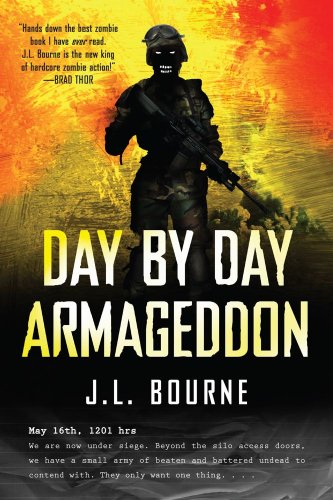
Review: Day By Day Armagedon, by J.L. Bourne


Does exactly what it says on the box. A never named navy officer decides to keep a diary literally days before a zombie flavoured kind of hell breaks loose, and the book is a day by day chronicle of his efforts to survive.

There are a lot of things to like about this book. If we start at a purely aesthetic viewpoint, this is a book that makes me glad to have resisted the ebook wave. I don’t mean the cover (which isn’t terrible but I wouldn’t say I’m in love with it), I’m talking about the pages. They are adored with handwritten notes, pictures (both hand drawn and photographs), coffee rings and tears and what are possibly blood stains. There are also sections of texts that have been scribbled out and rendered unreadable, which brings to mind one of my all time favourite books, House of Leaves. It makes the book feel more immediate and authentic, and it makes you feel closer to our unnamed hero.

Of course no quirky design will turn rubbish prose into good, but thankfully J.L. Bourne's text doesn’t need any help being good. Bourne's take on the Zombie apocalypse is a pleasing mixture of familiar and new ideas. He pays due homage to the zombie tradition while still managing to offer his own ideas without going too crazy with it.

But the real shining point, for me, is the narrator. Our hero is a military man, and this shines through in every aspect of the text. It's sometimes obvious, such as the use of military terminology, which is a little confusing at first but the author skilfully supplies enough context for us to figure out what all the words mean. (What, an author who doesn’t treat his readers like idiots? Imagine!) But his military background is also clear in his short, efficient sentences and the methodical way he views the world.

This book is an exercise in reading between the lines. As I mentioned, Protagonist McNoname writes his journal in a very straight forward, no fuss kind of way. He doesn’t dwell overlong on his feelings or hopes, he concerns himself with what is needed to survive; lists of remaining rations, brainstorm ideas of zombie proof fortresses and the like. When he meets other suriviors he writes about them foremost in terms of what the skills they offer, and when he finds those skills lacking he outlines plans to teach them. (Not, you may note, abandon them).

But when we look closer a picture of him begins to emerge. We start to see that he has always been a loner (when shit starts to go down he deserts the military without hesitation), and pretty bad at relating with women. He mentions briefly using army equipment to spy on an ex-girlfiend, and his thoughts when a friend calls to say his wife had left are also very telling. He refers to his guns as females, and in the early days of the book he is at his most considerate when he is carefully cleaning and maintaining them.

It is pleasure to watch, as the book progresses, our hero start to trust and depend on the few other survivors he joins up with. It’s also a pleasure to be in the hands of a perfectly capable protagonist. Often zombie books, or all post-apocalyptic books, are told from the point of view of unremarkable people who have to quickly learn how to survive. Our hero already knows how to survive, he just needs to learn how to love. (Oh man, that did not sound so cheesy in my head I promise…)

My biggest complaint with the book is the ending, or rather lack thereof. We are left with some major plot threads dangling in the wind, and while there is a sequel it’s still annoying to have to wait to get my hands on it. But then again, if the worst thing you can say about a book is that you want to read more right now instead of later, then it’s probably a pretty good book!

This book, I got it how? I actually won this one from Graeme's Fantasy Book Review. Cheers Graeme!


Sunday, August 15, 2010

YA books I have loved, and loved well.

The Book Smuggler's, bless their cotton socks, have been hosting a YA extraveganza this week. Reading all the excellent reviews and discussions about all things YA made me think, all nostalgic like, back to the time when I was myself a young adult. Back when reading was more than something I loved, it was something that literally got me through the day. Back when books kept me up at night, not because I was reading them but because I couldn't stop thinking about them. I love books different now, not less necessarily but perhaps with less intensity. Which makes me a little sad, but on the other hand at least I get more sleep now...

Here is a very small selection of some of the YA texts that most impacted my time as a YA, may I never again feel so angst ridden awkward as I did then.


Looking for Alibrandi, by Melina Marchetta: This book is everything a YA book should be. Josie is a third generation Italian-Australian girl who feels like she doesn't fit in anywhere. And you can't really blame the girl for thinking that. She's the poor scholaship kid in an upper class private school, the girls there pick on her because she's a "wog" (and poor!) and the Italian community picks on her because (the horror!) she's a bastard. Now in my mature years (snort) I can appreciate the way Marchetta explores the issues and prejudices that face immigrants. Josie is torn between how she sees herself as an Australian and how she sees herself as an Italian, and these broad cultural conflict are mirrored on a more personal level when the father she never met reenters her life and she must decide if she is an Alibrandi or an Andretti (that would be Dad's last name).

But you know, back then I didn't care about that heavy stuff. I cared about Josie. She was funny, an awesome self-depreciating brand of funny that to this day makes me laugh out loud. And she has a temper! There's this one scene where a rich snobby girl calls Josie a wog and Josie breaks her nose with a science text book which is just kick ass, and still hands done one of my favourite moments in any book ever. (Plus the rich snobby girl is not just a rich snob girl stereotype, she's as real a person as Josie is, just like every character in this book).

Plus, there are boys. Who will Josie end up with? Working class Jacob who acts like he cares about nothing but actually cares a lot about everyhing? Or maybe it will be upper class John who is ridiculously likeable? You know how in a lot of books where's there's one girl and two boys is actually pretty obvious who she'll end up with? Not so here, at all. And Jacob and John aren't just there to be love interests either, there's a very real sense of their lives existing outside of Josie.

But just be careful, because this book will also break your heart. And I'm not even kidding about that, it will take your heart and rip it up and scatter the bits. Looking for Alaska has nothing on Looking for Alibrandi, and you'll love it even more.


Guitar Highway Rose, by Lois Lowry: At it's heart this is a book about two crazy kids learning that their parents used to be crazy kid's once, and it's about their parent's learning that, oh shit, are kid's aren't little kid's anymore. But it's not nearly as boring as that might make it sound. We have Rose, who's parents are starting to edge towards divorce, and we have Asher who's parent's have just split up. Asher is the new kid in school, he's a free spirit who poo poos the dress code and is wretchedly homesick. Rosie just wants to escape, damn it, anyway she can. So it's no great shock that the two end up running away together and having the sweetest romance you have ever seen. (Sweet as in she falls asleep on his shoulder and he doesn't dare move lest he wake her, not sweet as in 'sweet wheels bro.')

My favourite thing about this book has always been the nontraditional way in which is was written. It's made up of lists and stream of consciousness chunks and school reports and journal entries, (all with clever headings) but at no point is it anything other than assessable. It's hard to explain, but very effective. I feel like we learn more about Asher by reading a list a of his pocket's contents then we would in five pages of traditional narrative.

Another way in which this book is unique in the treatment of the adults. They are every bit as real and complex as the teenagers, and when I read this book for the first time that kinda blew my mind a little bit.


Tomorrow, When the War Began (and it's sequels), by John Marsden: Holy shit, you guys. Holy shit. Basically a group of friends go camping and come home to find that Australia gets invaded by never named foreigners. Naturally they go all guerrilla warfare on the invaders.

Elle is hands down without a doubt my favourite literary heroine, from any genre. She's flawed up the wazoo, stubborn and bossy and jealous. But she's also resourceful and strong and loyal and my god is she brave. (When people suggest that male writers can not write females I throw one of the Tomorrow books at their head).

And the other characters are just as flawed and amazing in their own ways. My favourite was always Lee. He's this beautiful, complex guy who might have lived his whole life in his own intense quite way but the war brings out a darkness inside of him, and he does things the others can not bring themselves to. And even though they know these things have to be done, and they're relived that Lee has done them, they pull away from him a little. It's painful and real and so damn human. (There's an amazing scene where they're hiding out in a house and Elle finds Lee, who pre-war was a musician, sitting at a piano with his hands hovering over the keys. He can't play it because of the noise, and I doubt many authors could have captured the bittersweet pain of the moment as well as Marsden).

Marsden definitely doesn't pull back from anything. There's blood and snot and tears and sex and death and more shades of grey than a George R. R. Martin book. Really I can't recommend the series enough.


So, until next time the nostalgia strikes or the Smuggler's have their next YA week, we return to our regularly scheduled reviews!