I mean, I was only gone for a minute...
I did strongly consider deleting all my old reviews and starting fresh, but I decided to let them be, awkward and defenseless little things that they are. Like baby horses.

Saturday, June 8, 2019

Wednesday, October 10, 2012
The Perk of Being a Wallflower, by Stepen Chbosky
 Oh man, 16 year old me would have lived and died with this book. I’m not
kidding, it’s like Chbosky rounded up a bunch of teenagers, whizzed them up in
a blender and was left with a pure distilled essence of teenage angst, which he
then used as ink to pen this novel.
Oh man, 16 year old me would have lived and died with this book. I’m not
kidding, it’s like Chbosky rounded up a bunch of teenagers, whizzed them up in
a blender and was left with a pure distilled essence of teenage angst, which he
then used as ink to pen this novel.
Not that I mean to sound dismissive of teenage emotions. I still
remember what it was like to be that age. In a lot of ways it was amazing, and
in a lot of ways it really, fucking sucks. Chbosky really captures that. The
feelings of wonder and discovery and the feelings of pain and awkwardness.
Like I said, 16 year old me’s life would have been changed by this book.
I think the way Charlie (our weepy protagonist) talks about his parents would
have opened my eyes and had a real impact on how I looked at and related to my
mum and dad. And the way he interacts with his friends, the positive and negative, would have helped me deal with the occasionally great occasionally brutal arena of teenage friendships. Unfortunately 25 year old me found the book to be too overwrought
and dramatic. I knocked it out in a day and enjoyed it well enough, but whereas
as young adult books like ‘The Fault In Our Stars’ or ‘How We Will Now’ can
connect to me and move me, all ‘Perks’ really did was make me feel old and
alienated. Which I guess is the point. This a young adult book in the purest
sense of the word. A book that will speak only to young adults, and leave all others
somewhat confused by its success.
(Actually a lot of the negative reviews I see for this book complain
that Charlie seems younger than his age and emotionally stunted. Which to me
was like complaining that that a one legged character only seemed to have one
leg. Well, yeah, duh. He is emotionally stunted. That’s kinda the point…)
I hope that one day I have kids who I can get to read this book, and
hopefully they will love it in the way that I’m just too old to do.
I bought this book
Monday, September 17, 2012
Review: Bitter Seeds, by Ian Tregillis
 You
definitely can’t fault bitter seeds on a sentence by sentence level. From the
opening to the finish this book is overflowing with beautifully crafted imagery
and interestingly worded lines. Nor can you fault the plot. It’s world war 2. The
nazi’s have engineered a team of soldiers with supernatural powers, while the
British have enlisted a group of warlocks to broker deals with dark and
terrible powers.
You
definitely can’t fault bitter seeds on a sentence by sentence level. From the
opening to the finish this book is overflowing with beautifully crafted imagery
and interestingly worded lines. Nor can you fault the plot. It’s world war 2. The
nazi’s have engineered a team of soldiers with supernatural powers, while the
British have enlisted a group of warlocks to broker deals with dark and
terrible powers.
And
you definitely can’t fault the characters! Will, Marsh and Klaus are well rounded,
flawed and believable. Will, an upper class young man whose alcoholic
grandfather forced him into a world of dark magic, is charming and genuinely
funny. His character arc is the most tragic, as we watch him fight against
becoming all the things he hated about his grandfather.
Street
urchin turned spy Marsh is dark but will a concrete centre of nobility, he’s
believably good at his work and more than a little bad ass. While he has no
mercy for those on his level, and time again Marsh defends those weaker than he
is. This instinct is handled quite subtlety, and it was an impressive piece of
characterization. I also enjoyed the relationship he has with his boss/father
figure. An impressive example of showing over telling.
And
Klaus, while on the outside should be wholly unlikable, garners the reader’s
sympathy through his tragic upbringing and love for his sister. What makes it
worse is the guy clearly can’t see how abusive and awful his life has been, all
he wants is to impress the man who inflicted much of the suffering upon him.
It’s a clever way of making the reader actually care about what happens to a
nazi character, without having to make them secretly all noble and good inside.
His sister, who has see the future, is a more mysterious character. Tregillis takes full advantage of her abilities and it’s a lot of fun watching
her be twenty steps ahead of everyone. He also wisely never lets us inside her
head, making us view her through the eyes of others and thereby preserving her
mystery.
So,
prose, plot and characters can not be faulted. But sadly this book is really,
fatally, let down by the pacing. It’s too short, for a start. The whole war is
blitzed over in this relatively short volume. But that could have still worked,
if it weren’t for Tregillis’s maddening habit of only showing us the
aftershocks of events. None of the major decisions were made “on page-” we only
ever saw the characters discussing things after they had been implemented.
There are few action scenes, instead there are scenes where the characters deal
with what has already happened. For example; we have one sentence of Marsh
saying hello to a girl, and then the next scene he is in is their wedding. It’s
very jarring.
These
jumps in time also means that instead of smooth character progression the
characters appear almost like new people each time we meet them, Will
especially. Of course it’s a good thing when characters change- that’s what we
want! But the whole point is for the reader to see it happening, not to jump
from a to c with nothing inbetween. It keeps the characters at arms length,
which is a shame because like I said they are very well crafted and it would
have been easy to get really attached to them, which would have given the
book’s ending a much bigger impact.
I
think when you out the pros and the cons together what you're left with is a book
that’s not bad, but not entirely good either. I think I will read the next one
(even though the cover the new publisher has gone with lacks all the grace and
charm of the original cover of Bitter Seeds, which is what drew me to the book
in the first place), if only to see if Tregillis can bring his pacing up to the
same level as everything else.
I bought this book
Wednesday, September 5, 2012
Review: Blood Rights, by Kristen Painter
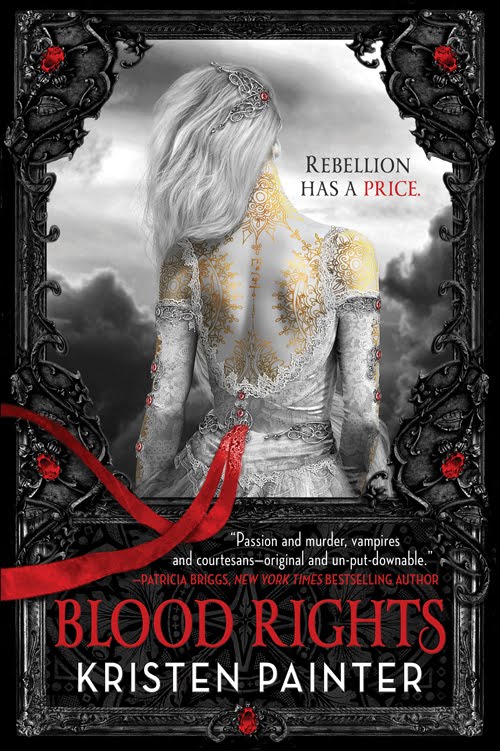
I
think this book falls firmly into the category of definitely not for me. While
I can objectively see why others like it (and I am sure my sister will go nuts
for it when I lend it to her) it didn’t really do much for me, and I don’t see
myself continuing with the series.
Why
did I even pick this book up? I want to say its because the plot sounded
interesting, because it does. A centuries old woman who has been raised to
serve vampires and feed them her high quality blood must flee to the “real”
world when her patron/owner is found murdered. Here she teams up with an exiled
and cursed noble vampire to prove her innocence. I mean, it’s not
groundbreaking as plots go, but in the rights hands there was a lot of
potential there. But even though I want to claim it was the plot that drew me
to this book, if I’m being honest I think I have to admit it was the cover.
Blacks,
greys and muted gold and that shock of bright blood red. Really striking. It’s
sensual and gothic and really drew me in. I was imagining a rich, dark tale to
match the cover, something like Anne Rice’s early Vampire books, or Lianni
Taylor’s more recent ‘Daughter of Smoke and Bone.’ Something stepped in
atmosphere and personality.
Yeah…
I was sorely disappointed. Despite being set in the future ‘Blood Rights’
rarely feels like anything but present day. Aside from a few token gadgets,
technology has barely advanced. And despite the fact that our setting is “New
Florida,” and at one point we visit a Iranian controlled Paris, there is no difference in the way
society is presented compared to present day. Did you ever go to a high school
play and the sets were obviously from a different production with a few token
changes made? It’s like that- like the the book was originally set “now” and at
the last minute Painter made some purely cosmetic changes to make it more
“later.”
It
also feels overwhelmingly American. Which, ok, a solid chunk of it is set in America. But a
goodly amount is also set in Europe, and these
scenes are no different from the American based ones. I didn’t even realise
that the vampire sections of the book were European based until a character
explicitly mentions it. And our main character, Chrysabell, has lived her whole
life in Europe. Yet she comes across as just
another all American heroine. And not just that- she’s grown up with no modern
technologies, and yet being suddenly thrust into modern American society doesn’t
seem to faze her at all. And lets not forget that she’s supposedly 150 years
old, yet acts just like someone in her mid twenties. You can’t just say things
are so in a book, you have to actually show them to be so as well!
It
made the whole book feel bland and shallow.
This
was my main complaint with the book. The characters are nothing new, especially
if you’ve read any other urban fantasy novel before, but they’re not terrible.
The overall thin plot is ridiculously stretched out and the “twist” is easy enough to see
coming, but again, it’s serviceable. The problem is I’ve never been a huge fan
of urban fantasy, and this book (despite what I’d hoped) is pretty
much a standard, by the books, example of the genre.
Like
I said, I’m sure others will really like it- I can even see why. But it
definitely wasn’t my cup of tea.
I bought this book
Tuesday, August 28, 2012
Review: Memories of Ice, by Steven Erikson
 I can
name few books that I found as brutal and heart wrenching as the second Malazan
book, Deadhouse Gates. It was because of this that I went into Memories of Ice anticipating
a quieter, more introspective volume. A chance for me, the reader, to catch my
breath after the emotionally exhausting climax of Deadhouse Gates.
I can
name few books that I found as brutal and heart wrenching as the second Malazan
book, Deadhouse Gates. It was because of this that I went into Memories of Ice anticipating
a quieter, more introspective volume. A chance for me, the reader, to catch my
breath after the emotionally exhausting climax of Deadhouse Gates.
Hahahaha.
You can’t tell from where you’re sitting, but that’s hysterical laughter on my
part. I thought Deadhouse Gates was bad? Man, I had no idea. Erikson was just
getting warmed up, and in Memories of Ice we see exactly how far he is willing
to push his poor, poor characters.
It
was a real treat to get back to the Gardens of the Moon gang-
especially the Bridgeburners. They spend much of the series debut on their own
and undergoing sneaky missions, which was fantastic (I’ll never look at
roadworks the same way again!), but it was also really cool to see them in a more
"traditional" army setting. A good chunk of this book is the Bridgeburners and
the rest of Dujek's army marching from point a to point b, which on paper sounds
really boring. But it was just so cool to see how the Bridgeburner’s operate,
to see why others view them with such awe.
And
Anomander Rake and Caladan Brood! I am sure I am not the only reader who was
instantly fascinated with Rake in GotM and wanting to see much more of him. I
was equally keen to properly meet Caladan Brood, and to see how their
relationship operated. Memories of Ice does not disappoint on that front! Rake
is such a fantastic character. Through his burgeoning friendship with
Whiskyjack we see a more “human” side of him, but at the same time he remains
as alien and mysterious as ever. (But clearly the award for coolest bromance has
to go to Toc the Younger and Tool. Loved every second of page time those two
shared. Did not however love what happened to Toc once he went his own way, in the
sense that it was fantastic reading but not fantastic for my heart…)
And
this is really only one of many storylines that make up Memories of Ice. The
siege of Capustan was just…. Wow. Easily the most graphically violent thing I
have ever read (and I’ve read/suffered through American Psycho…) and yet the
blood and gore never feels gratuitous. Rather it felt like every other author
of a fantasy battle has been suger coating, and here Erikson is revealing the
awful bloody truth of it. Which is not to say that I’ve never read a bloody
battle scene before, but there’s just something so awful and visceral about the
siege of Capustan.
I
think if Deadhouse Gates was the book where I started to really care of the
Malazan world and it’s characters, then Memories of Ice has to be the book where
I actually started to understand what was going on. The warrens started to make
sense, and I felt like I was getting a handle on the gods and ascendants and
how they operate. I definitely wasn’t leaning as heavily on chapter summaries
to make sense of things, and I was able to figure out who characters were and
make connections all on my own.
But I
really wasn’t kidding about Erikson inflicting awful things upon his
characters. Coltraine remained a very aloof and removed character throughout
Deadhouse Gates, and his fate nearly broke something inside of me. When equally
bad things start to happen to characters a little closer to home, man, it was
tough. It was hard to read, but equally hard to stop reading, if that makes
sense. This book was brutal and awesome, in the literal sense of the word, and
finishing it left me drained. But damn if I didn’t love every second of it.
I bought this book
Friday, August 17, 2012
Review: A Long, Long Sleep, by Anna Sheehan
 I
don’t know what I was expected when I picked up this book, but it certainly
wasn’t what I got! The plot: girl wakes up after a few decades in a cryogenic
chamber, finds she is heir to her parents' multi-billion dollar corporation and
not long after finds that someone wants to kill her! Oh no! I think I was
definitely swayed by the cover when it came to buying this one, because I don’t
know about you but that plot leaves me a bit cold. It’s the part where someone
wants to kill her that does it. Why do books always have to shove stuff like
that in? The fact that she’s woken up in a strange future with everyone she’s
ever known dead should be drama enough, why add more?
I
don’t know what I was expected when I picked up this book, but it certainly
wasn’t what I got! The plot: girl wakes up after a few decades in a cryogenic
chamber, finds she is heir to her parents' multi-billion dollar corporation and
not long after finds that someone wants to kill her! Oh no! I think I was
definitely swayed by the cover when it came to buying this one, because I don’t
know about you but that plot leaves me a bit cold. It’s the part where someone
wants to kill her that does it. Why do books always have to shove stuff like
that in? The fact that she’s woken up in a strange future with everyone she’s
ever known dead should be drama enough, why add more?
Thankfully,
it seemed the author agreed with me. The attempted murder of Rosalinda is
definitely not the focus of this book, and if you go in wanting an action
packed ride you’ll be sorely disappointed. A Long Long Sleep is far more subtle
then that, and it’s really more of a slow burning character study than anything
else. And I loved it!
I
loved how when we first meet her it’s so easy to dismiss Rosalinda as weak; the
spoiled, soft product of loving but overbearing parents. But then, slowly, we
start to see that not everything is as it seems, and I can’t think of a way to
discuss this further without risking spoilers, so you’ll need to just take my
word that the way the sinister undertones to Rosalinda’s past slowly build is
just masterful.
I
also loved the setting. The world has moved on without Rosalinda and watching
her struggle to cope with the new technology and vernacular of the world was
believable and interesting. The time Rosalinda is from is already far advanced
compared to “our” time, yet Sheehan still manages to make her feel old fashioned compared to everyone
around her. The whole book has a really lovely old fashioned feel to it, like an old photograph of a spring day.
I
loved that Rosalinda is woken by a kiss by an impossible handsome and charming
young man who, having read a few books in my time, I immediately pegged as her
eventual love interest. Actually, no, I didn’t love that. What I loved is that
things turned out to be far more complicated. Again, spoilers!
I
loved the book actually pulled off a twist that I did not see coming until the
very last moment. A twist that, despite taking me by surprise, was completely
obvious in hindsight. (Which is how all twists should be).
I
mean, it’s not perfect (although my gushing might be suggesting otherwise).
There is that whole attempted murder side plot, which to be honest feels a
little tacked on, like maybe the publishers didn’t quote know how to market a
YA book that didn’t feature murder or forbidden romance or soul mates.
But
that’s a small complaint, and this is easily one of the best YA books I have read in
a long time. It stands completely alone, but despite that I can’t help but hope
for a sequel, and anything else by this author really. Definitely one to watch!
I bought this book
Sunday, August 5, 2012
Review: A Companion to Wolves, By Sarah Monette and Elizabeth Bear
 I
have read many books that would have been great if only the author had been a
little more skilled, but I think this was the first time I’ve read a book that
was bad, but made enjoyable in the hands of two really great authors. Because
seriously, I think it took every ounce of talent and skill that authors
Elizabeth Bear and Sarah Monnette possess between them to keep this book from
being a ridiculous mess.
I
have read many books that would have been great if only the author had been a
little more skilled, but I think this was the first time I’ve read a book that
was bad, but made enjoyable in the hands of two really great authors. Because
seriously, I think it took every ounce of talent and skill that authors
Elizabeth Bear and Sarah Monnette possess between them to keep this book from
being a ridiculous mess.
Set
in snowbound northern land all that stands between men and trolls are the- well,
crap. I can’t remember what they’re called. Wolfen-something. Or was it
something-wolf? Wolf dudes. Men who bond with enormous wolves and use that bond
to take down the ferocious trolls.
This highlights the main problem with this book, or at least it was for me. The names! I
don’t think I’m a lazy reader, I’m more than willing to put in a bit of effort
to keep track of things, but I had no chance of keeping all the characters in
this book straight. They’ve all got really long Norse inspired names that I
could barely pronounce, and a bunch of them are only different by a few
syllables. And it doesn’t help that a few chapters into the book a bunch of the characters turn around and change their names! Argh!
And
here is where the author’s skill that I was talking about comes into play.
Because by name alone I had no idea which character was which, but I was able
to keep them all fairly straight because their actual character was so well
written, as was the way the protagonist (Isolfr, one of the few names I
remembered, because it was short and the only one that started with an I…)
reacted to and interacted with them. I’ve not read anything by Elizabeth Bear
(yet) but I know from Sarah Monnette’s books that she is fantastic at creating
distinctive characters so I have to assume that this was her influence. It kept
me reading when I otherwise would have been tempted to give up.
I
initially picked this book up because I’d heard it provided a more realistic
take on the common man-anirmal-bond trope, a look at what such a bond would
really entail. Having now read the book I don’t think it does this- or at least
I don’t think it doesn’t it in a well rounded way. Instead what the book really
delves into is what sex would be like for a man bonded to an animal, but it just skims over everything else. Personally
I think Robin Hobb offers a more realistic and thorough take on this kind of
bond in the Farseer books- she might not explore sex as deeply, but nor does she focus on that one aspect
to the neglect of others.
The
sex scenes in this book run the gamut from sweet to brutally graphic and
confronting, and in this it has to be said that Bear and Monnette have not
shied away from the darker possibilities of a man/animal connection. There is a lot
of discussion of what does and doesn’t constitute consent, and it does make for
thought provoking (if at times uncomfortable) reading.
Something
else that is explored with deft skill, although very much in the background,
are issues of gender. I liked how this was handled in a subtle way. It's not the focus of the book, but nor does the book simply ignore the question. Considering the cast is almost entirely male, I thought this was impressive.
Ultimately
this is a very readable book. Despite its heavy themes the pages just fly by,
and while I think it has too much substance to be called popcorn fiction it certainty
has a lot in common with that genre. I will definitely be picking up the next
book in the series (I’d thought this was a stand alone so I was pleased that
there even was a “next book”) and am interested to see where the authors take
it.
I bought this book
Subscribe to:
Posts (Atom)