Monday, July 29, 2019

Carnival, by Elizabeth Bear

I enjoyed this a lot, but man it took me for. ev. ver. to read. It's really long for a start, but it's also throws a lot of stuff at you from all directions. And it's all cool stuff, but I had to go up a gear in my brain to keep track of it all.

We have two ambassador-spies, (fact: I bought this book based solely on the promise of ambassador spies), Vincent and Angelo. (His full name is Michelangelo Osiris Leary Kusunagi-Jones, and there's an explanation for this ridiculousness in the book, a good one even, but still. What a name). They were once lovers, but have been apart for seventeen years after their affair was discovered. Homosexuality, under the rule of the Governors who represent Old Earth and control much of this universe, is super illegal. They were lucky not to be straight up killed for it.

But now they're needed for this mission to a planet called New Amazonia. As the name suggests, it's all super matriarchal and shit. There are men, but they are very much second class citizens, divided into two roles: stud, and gentle. Gentle males, or "safe" males as the New Amazonian society views them, are gay. This is why Vincent and Angelo have been reunited; the woman who rule New Amazonia would only accept "gentle" ambassadors. (So much of the New Amazonian and Old Earth societies is interesting subversions on ours. Not just the gender stuff, but also the approach to energy use and resources and stuff. It was really cool).

And the Governors, on behalf of Old Earth, really need this diplomatic mission to go well. Energy use is a huge issue for the rest of the universe, but New Amazonia has a seemiglny unlimited supply. Vincent and Angelo are to get them to share their secrets, peacefully or.... otherwise.

But both men have their own agendas, and this is where a good chunk of this book struggled for me. Figuring out Angelo and Vincent's differing agendas and keeping them straight was a real mission. Oh and also Lesa, our New Amazonian POV, who also has an angenda other than the one everyone is pretending to have on the surface.

I think because both of them had complicated backstories and complicated true purposes for being on New Amazonia, and it tied into the complicated history of the universe Bear had created, and was influenced by the complicated politics of social strata of New Amazonia. So all these complicated little balls were bouncing off each other in all directions and I was expected to juggle them.

After the fifty percent point I started to feel like I understood the history and politics that were informing what everyone did. The reality of the Governors and everyone's motivations and all of it clicked into place, which made the second half way more enjoyable for me than the first. I still enjoyed the first half, I was just confused a lot. I really loved watching Vincent and Angelo circle around and figure out what their relationship looked like now. The way they would describe each other and the way they interacted was like soothing aloe vera on the confusing burn of everything else.

I thought more than once while I read this that it would be enjoyed by folks who loved the recent and fantastic This Is How You Lose The Time War. It doesn't reach the same poetic heights, but that 'spies who love each other' vibe is all over this. You and Me vs. all our bosses.

So yeah. I have no idea why this book has so few ratings, because Elizabeth Bear is fantastic and this is a fantastic book by her. Imagine being so prolific that a book like this could become almost forgotten amid your incredible back catalogue?

Saturday, June 15, 2019

The Heart of the Circle by Keren Landsman

What a strangely compelling book this was. And when I say compelling I don't just mean your standard 'one more chapter whoops bedtime was three hours ago' kind of compelling. This book was like quicksand.  When I first sent it to my kind I opened it just to check that it had worked, and the next thing I knew I was four chapters deep. I'd plan to read a chapter or two with lunch and lose an afternoon. I was late back from my lunch-break at work yesterday and, yes, there were missed bedtimes.

Pretty impressive, considering I don't even know if I liked it that much. Hell, I honestly can't even pinpoint why I found it as compelling as I did. Take the prose, for example. It might be a result of the translation (this book was first published in Hebrew), but I found it to be on the clunky side. And yet there was an open quality to it, a complete lack of pretense, that made reading the sentences almost effortless. It literally felt like the story was just flowing into me.

The plot, I should have loved. Not because it's exiting or twisty, but because it's really not the focus. Plots happening in the background while characters angst at each other is basically my favourite flavour of book, but even if the plot is in the background it should still make sense. I mean the plot here isn't too complicated; in a world where sorcerers are both common and discriminated against a far-right group wants to kill all the non-sorcerers and take control. Our protagonist, an empath named Reed, and his friends want to stop them. The issue I had is that too often B didn't seem to follow logically from A. It would be like if a car crashed into a tree, and the driver said 'great, now I have to buy more milk!' and the other passengers are like, 'obviously.' There were too many, 'wait, what?' moments from me.

I did really like the worldbuilding. The different kind of sorcerers and how they were introduced. I liked how Reed's empathetic abilities were explored, although I was a little uncomfortable with how they tied into mental health and depression. Honestly though this is not an area I have enough experience in to know if the books portrayal of that was problematic, though the fatalistic way everyone just seemed to accept that all empaths would struggle with depression and suicide seemed wrong to me.

My favourite part of this book was the seers. I liked that they were common, because normally a seer character is rare and OP in any universe. Here they're a dime a dozen, and they're all competing to push things there own way. Little touches like how two seers can become quick friends by jointly "seeing" all the future conversations they might have was one cool example of the unique approach the book takes to them. Although I have to wonder why things are so bad for sorcerers around the world if there are so many seers on their side?

I guess every aspect of this book I could describe as 'pretty good, but...' And yet somehow all of these flawed parts made up a whole that I couldn't read fast enough. Strangely compelling really is the best way I can describe The Heart of the Circle. A big thanks to netgalley for letting me read it.

Monday, June 10, 2019

This Is How You Lose The Time War by Amal El-Mohtar and Max Gladstone

A woman approaches you. She's wearing a dark coat. She reaches into an inside pocket and holds something out. "Hey you," she says, "look at this." You're not entirely sure what you're looking at; but it's beautiful. Multi-faceted like a diamond. Intricate like one of those sculptures where the artist makes stone look like lace. You try to get a closer look, but she whisks it away and holds out her other hand. This one holds something as alien as the first thing, just as beautiful, just as intricate, but wholly different. Even as she tells you to look at it she's pulling it away, but there's something new back in her first hand....

This is what reading This Is How You Lose The Time War feels like. An onslaught of sharp and beautiful things, one after the other, no context and no mercy. Neither of the heroes, if heroes is even what you could call them, strike me as the kind of women prone to hand-holding, so I guess this makes sense. 'Keep up or drown and I really don't care which,' is a sentiment I could see coming from either one of them. It's certainly how they feel about each other. At first anyway.

Every second line of this novella is the kind of startling perfection most other books would hinge their entire selves around. The worldbuilding, or at least the worldbuilding shown to the reader is flashes and reflections, is rich and raises endless questions. It's not hard to picture a multi-volume sci-fi epic set in this world(s), but at the same time I didn't find myself unsatisfied with the briefness of this story. And the inherent briefness of a novella is nine times out of ten my main issue with the format, so that's high praise from me. It was similar to Kai Ashante Wilson's two breathtaking books that way; the prose is rich enough and just challenging enough that each lines carries the weight of two, or three.

If you were to strip this prose back to the barest language I suppose you would find a plot that lands on the scant side. Easy to spoil, with beats that aren't impossible to predict. You might notice that a good third of this novella is just two (human? delightfully unclear) woman confessing their feelings for each other in different ways while nothing else really happens. Although I think even in this scenario you'd have be impressed by how time travel is handled here, how all the usual paradox's aren't ignored so much as not even dignified with a response.

But anyway, these complaints that might ruin another book mean little here, because you're not stripping the prose away. It'll be there to paint scenes so soft you could almost sink into them, to carve moments so sharp you might look up from your reading to check you're not actually losing blood. When you finish a book like this you know you've read something special. Even if you didn't love it, even if you flat-out hated it, it's something wholly unlike anything else. And wholly different things are rare gifts in this world.

(My thanks to netgalley for supplying me with a review copy of this book).

Saturday, June 8, 2019

Strange Grace by Tessa Gratton

I know it's the showy epics that span years, or decades or, (lord help me), full on centuries, that make people go ohhhhh such skill! such talent! such a hole in my wallet! but my heart will always belong those authors who can take a few days and make a whole book out of them.

Like Strange Grace. At it's centre - and this isn't me being an insightful reviewer and talking about the books thematic core, I mean it's literal centre, the midway point - is a sacrifice. The rest of the book is the few days before it, and the few days after. Which might sound like spoilers, but it's not really.

The sacrifice, for instance, is something the residents of Three Graces, the village in which this book is set, are very upfront about. This isn't some shadowy conclave doing what needs to be done while the ignorant sleep. Even the children know that two hundred years ago a witch made a deal with the devil that lives in their forest, and now their village is blessed with perfect weather and perfect health and perfect harvests. And every seven years they send a boy into the forest to die.

And not, like, the weird boy who keeps setting little fires that one really likes much anyway. Only the best will do for the sacrifice, and this year it's pretty obvious that the best is Rhun. And let me just stop here to appreciate one of the many ways in which this book shines. Rhine is a genuinely good and wholesome young man, he's handsome and kind and good with small children and, shockingly, not at all boring. Writing an interesting areshole is easy, writing an interesting walking embodiment of lawful good, now that takes skill.

Although if interesting arseholes are your jam, don't worry, you're also covered. Arthur Crouch spent the first seven years of his life thinking he was a girl, because his mother disguised him as such in an attempt to save him from the sacrifice, and now he has issues. And as I typed that I realise how flippant it sounded, which is unworthy of the insightful way the author handled this aspect of Arthur's character, or the fact that it is only a single aspect of his wonderful, prickly, total arsehole character.

The final protagonist of Strange Grace is Mairwen, daughter of a witch and one of the young men who was sent into the forest to die. She's very invested in the idea of one day recovering her father's bones from the forest, but it's like she's never entirely sure if it's because she wants to lay him or rest or if she just wants an excuse to go inside. She's kinda obsessed with the evil devil forest, like you know how some girls really love horses? Like that, except its an evil devil forest full of mutated wolves and deer-abominations and shit.

Mairwen also loves Rhun, which is fun because she's stubborn and prickly and he's so easy-going and kind. She also loves Arthur, which is fun because he's stubborn and prickly but a slightly different flavour of it and they clash like crazy. What's even more fun? This isn't a love triangle. Because Rhun loves Arthur, and Arthur loves Rhun, and they both love Mairwen, and I've said it before and I'll say it again, there is not enough polyarmory in fantasy. Watching the three of them navigate a path towards each other was my favourite part of the whole book.

I enjoyed the mystery of the sacrifice slightly less (I know up there I said there was no mystery, but I'm trying to be vague here), so by the end of the book I was a little annoyed that it was getting more page-time than the three interacting. But to be clear, the sacrifice mystery was like really good chocolate cake, it's just the Mairwen and Arthur sniping at each other and Rhun loving Arthur right down to his worst parts was like the best chocolate cake you've had in years. Both are great, but you can't blame me for wanting more of one than the other. But I am aware that this is very much a me preference and not a fault in the book itself.

What else can I say about this book? The prose is lovely, the atmosphere spot on, the forest and it's devil perfectly creepy, and there are twists I saw coming and a few I didn't. Highly recommended, especially to fans of Stiefvater's Raven Cycle. (The atmosphere, characters, and things the book focuses on are what made me think of TRC again and again, and I actually found Strange Grace in a review for a different book that was being pushed as 'just like TRC' but in fact was like an off-tasting store brand version of TRC. The reviewer offered Strange Grace as an example of something that actually was like TRC, and that reviewer was correct).

And I'm back!

I mean, I was only gone for a minute...

I did strongly consider deleting all my old reviews and starting fresh, but I decided to let them be, awkward and defenseless little things that they are. Like baby horses.

Wednesday, October 10, 2012

The Perk of Being a Wallflower, by Stepen Chbosky


Oh man, 16 year old me would have lived and died with this book. I’m not kidding, it’s like Chbosky rounded up a bunch of teenagers, whizzed them up in a blender and was left with a pure distilled essence of teenage angst, which he then used as ink to pen this novel.

Not that I mean to sound dismissive of teenage emotions. I still remember what it was like to be that age. In a lot of ways it was amazing, and in a lot of ways it really, fucking sucks. Chbosky really captures that. The feelings of wonder and discovery and the feelings of pain and awkwardness.

Like I said, 16 year old me’s life would have been changed by this book. I think the way Charlie (our weepy protagonist) talks about his parents would have opened my eyes and had a real impact on how I looked at and related to my mum and dad. And the way he interacts with his friends, the positive and negative, would have helped me deal with the occasionally great occasionally brutal arena of teenage friendships. Unfortunately 25 year old me found the book to be too overwrought and dramatic. I knocked it out in a day and enjoyed it well enough, but whereas as young adult books like ‘The Fault In Our Stars’ or ‘How We Will Now’ can connect to me and move me, all ‘Perks’ really did was make me feel old and alienated. Which I guess is the point. This a young adult book in the purest sense of the word. A book that will speak only to young adults, and leave all others somewhat confused by its success.

(Actually a lot of the negative reviews I see for this book complain that Charlie seems younger than his age and emotionally stunted. Which to me was like complaining that that a one legged character only seemed to have one leg. Well, yeah, duh. He is emotionally stunted. That’s kinda the point…)

I hope that one day I have kids who I can get to read this book, and hopefully they will love it in the way that I’m just too old to do.

I bought this book

Monday, September 17, 2012

Review: Bitter Seeds, by Ian Tregillis


You definitely can’t fault bitter seeds on a sentence by sentence level. From the opening to the finish this book is overflowing with beautifully crafted imagery and interestingly worded lines. Nor can you fault the plot. It’s world war 2. The nazi’s have engineered a team of soldiers with supernatural powers, while the British have enlisted a group of warlocks to broker deals with dark and terrible powers.

And you definitely can’t fault the characters! Will, Marsh and Klaus are well rounded, flawed and believable. Will, an upper class young man whose alcoholic grandfather forced him into a world of dark magic, is charming and genuinely funny. His character arc is the most tragic, as we watch him fight against becoming all the things he hated about his grandfather.

Street urchin turned spy Marsh is dark but will a concrete centre of nobility, he’s believably good at his work and more than a little bad ass. While he has no mercy for those on his level, and time again Marsh defends those weaker than he is. This instinct is handled quite subtlety, and it was an impressive piece of characterization. I also enjoyed the relationship he has with his boss/father figure. An impressive example of showing over telling.

And Klaus, while on the outside should be wholly unlikable, garners the reader’s sympathy through his tragic upbringing and love for his sister. What makes it worse is the guy clearly can’t see how abusive and awful his life has been, all he wants is to impress the man who inflicted much of the suffering upon him. It’s a clever way of making the reader actually care about what happens to a nazi character, without having to make them secretly all noble and good inside. His sister, who has see the future, is a more mysterious character. Tregillis takes full advantage of her abilities and it’s a lot of fun watching her be twenty steps ahead of everyone. He also wisely never lets us inside her head, making us view her through the eyes of others and thereby preserving her mystery.

So, prose, plot and characters can not be faulted. But sadly this book is really, fatally, let down by the pacing. It’s too short, for a start. The whole war is blitzed over in this relatively short volume. But that could have still worked, if it weren’t for Tregillis’s maddening habit of only showing us the aftershocks of events. None of the major decisions were made “on page-” we only ever saw the characters discussing things after they had been implemented. There are few action scenes, instead there are scenes where the characters deal with what has already happened. For example; we have one sentence of Marsh saying hello to a girl, and then the next scene he is in is their wedding. It’s very jarring.

These jumps in time also means that instead of smooth character progression the characters appear almost like new people each time we meet them, Will especially. Of course it’s a good thing when characters change- that’s what we want! But the whole point is for the reader to see it happening, not to jump from a to c with nothing inbetween. It keeps the characters at arms length, which is a shame because like I said they are very well crafted and it would have been easy to get really attached to them, which would have given the book’s ending a much bigger impact.

I think when you out the pros and the cons together what you're left with is a book that’s not bad, but not entirely good either. I think I will read the next one (even though the cover the new publisher has gone with lacks all the grace and charm of the original cover of Bitter Seeds, which is what drew me to the book in the first place), if only to see if Tregillis can bring his pacing up to the same level as everything else. 

I bought this book

Wednesday, September 5, 2012

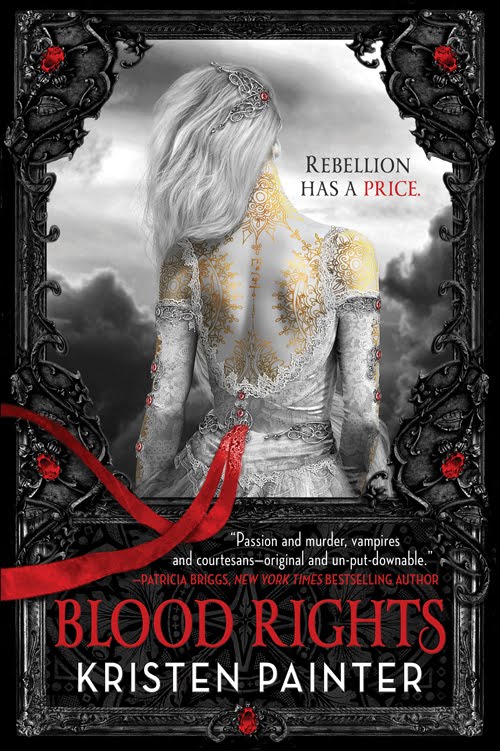
Review: Blood Rights, by Kristen Painter


I think this book falls firmly into the category of definitely not for me. While I can objectively see why others like it (and I am sure my sister will go nuts for it when I lend it to her) it didn’t really do much for me, and I don’t see myself continuing with the series.

Why did I even pick this book up? I want to say its because the plot sounded interesting, because it does. A centuries old woman who has been raised to serve vampires and feed them her high quality blood must flee to the “real” world when her patron/owner is found murdered. Here she teams up with an exiled and cursed noble vampire to prove her innocence. I mean, it’s not groundbreaking as plots go, but in the rights hands there was a lot of potential there. But even though I want to claim it was the plot that drew me to this book, if I’m being honest I think I have to admit it was the cover.

Blacks, greys and muted gold and that shock of bright blood red. Really striking. It’s sensual and gothic and really drew me in. I was imagining a rich, dark tale to match the cover, something like Anne Rice’s early Vampire books, or Lianni Taylor’s more recent ‘Daughter of Smoke and Bone.’ Something stepped in atmosphere and personality.

Yeah… I was sorely disappointed. Despite being set in the future ‘Blood Rights’ rarely feels like anything but present day. Aside from a few token gadgets, technology has barely advanced. And despite the fact that our setting is “New Florida,” and at one point we visit a Iranian controlled Paris, there is no difference in the way society is presented compared to present day. Did you ever go to a high school play and the sets were obviously from a different production with a few token changes made? It’s like that- like the the book was originally set “now” and at the last minute Painter made some purely cosmetic changes to make it more “later.”

It also feels overwhelmingly American. Which, ok, a solid chunk of it is set in America. But a goodly amount is also set in Europe, and these scenes are no different from the American based ones. I didn’t even realise that the vampire sections of the book were European based until a character explicitly mentions it. And our main character, Chrysabell, has lived her whole life in Europe. Yet she comes across as just another all American heroine. And not just that- she’s grown up with no modern technologies, and yet being suddenly thrust into modern American society doesn’t seem to faze her at all. And lets not forget that she’s supposedly 150 years old, yet acts just like someone in her mid twenties. You can’t just say things are so in a book, you have to actually show them to be so as well! 

It made the whole book feel bland and shallow.

This was my main complaint with the book. The characters are nothing new, especially if you’ve read any other urban fantasy novel before, but they’re not terrible. The overall thin plot is ridiculously stretched out and the “twist” is easy enough to see coming, but again, it’s serviceable. The problem is I’ve never been a huge fan of urban fantasy, and this book (despite what I’d hoped) is pretty much a standard, by the books, example of the genre.

Like I said, I’m sure others will really like it- I can even see why. But it definitely wasn’t my cup of tea.

I bought this book

Tuesday, August 28, 2012

Review: Memories of Ice, by Steven Erikson

I can name few books that I found as brutal and heart wrenching as the second Malazan book, Deadhouse Gates. It was because of this that I went into Memories of Ice anticipating a quieter, more introspective volume. A chance for me, the reader, to catch my breath after the emotionally exhausting climax of Deadhouse Gates.

Hahahaha. You can’t tell from where you’re sitting, but that’s hysterical laughter on my part. I thought Deadhouse Gates was bad? Man, I had no idea. Erikson was just getting warmed up, and in Memories of Ice we see exactly how far he is willing to push his poor, poor characters.

It was a real treat to get back to the  Gardens of the Moon gang- especially the Bridgeburners. They spend much of the series debut on their own and undergoing sneaky missions, which was fantastic (I’ll never look at roadworks the same way again!), but it was also really cool to see them in a more "traditional" army setting. A good chunk of this book is the Bridgeburners and the rest of Dujek's army marching from point a to point b, which on paper sounds really boring. But it was just so cool to see how the Bridgeburner’s operate, to see why others view them with such awe.

And Anomander Rake and Caladan Brood! I am sure I am not the only reader who was instantly fascinated with Rake in GotM and wanting to see much more of him. I was equally keen to properly meet Caladan Brood, and to see how their relationship operated. Memories of Ice does not disappoint on that front! Rake is such a fantastic character. Through his burgeoning friendship with Whiskyjack we see a more “human” side of him, but at the same time he remains as alien and mysterious as ever. (But clearly the award for coolest bromance has to go to Toc the Younger and Tool. Loved every second of page time those two shared. Did not however love what happened to Toc once he went his own way, in the sense that it was fantastic reading but not fantastic for my heart…)

And this is really only one of many storylines that make up Memories of Ice. The siege of Capustan was just…. Wow. Easily the most graphically violent thing I have ever read (and I’ve read/suffered through American Psycho…) and yet the blood and gore never feels gratuitous. Rather it felt like every other author of a fantasy battle has been suger coating, and here Erikson is revealing the awful bloody truth of it. Which is not to say that I’ve never read a bloody battle scene before, but there’s just something so awful and visceral about the siege of Capustan.

I think if Deadhouse Gates was the book where I started to really care of the Malazan world and it’s characters, then Memories of Ice has to be the book where I actually started to understand what was going on. The warrens started to make sense, and I felt like I was getting a handle on the gods and ascendants and how they operate. I definitely wasn’t leaning as heavily on chapter summaries to make sense of things, and I was able to figure out who characters were and make connections all on my own.

But I really wasn’t kidding about Erikson inflicting awful things upon his characters. Coltraine remained a very aloof and removed character throughout Deadhouse Gates, and his fate nearly broke something inside of me. When equally bad things start to happen to characters a little closer to home, man, it was tough. It was hard to read, but equally hard to stop reading, if that makes sense. This book was brutal and awesome, in the literal sense of the word, and finishing it left me drained. But damn if I didn’t love every second of it.

I bought this book

Friday, August 17, 2012

Review: A Long, Long Sleep, by Anna Sheehan

I don’t know what I was expected when I picked up this book, but it certainly wasn’t what I got! The plot: girl wakes up after a few decades in a cryogenic chamber, finds she is heir to her parents' multi-billion dollar corporation and not long after finds that someone wants to kill her! Oh no! I think I was definitely swayed by the cover when it came to buying this one, because I don’t know about you but that plot leaves me a bit cold. It’s the part where someone wants to kill her that does it. Why do books always have to shove stuff like that in? The fact that she’s woken up in a strange future with everyone she’s ever known dead should be drama enough, why add more?

Thankfully, it seemed the author agreed with me. The attempted murder of Rosalinda is definitely not the focus of this book, and if you go in wanting an action packed ride you’ll be sorely disappointed. A Long Long Sleep is far more subtle then that, and it’s really more of a slow burning character study than anything else. And I loved it!

I loved how when we first meet her it’s so easy to dismiss Rosalinda as weak; the spoiled, soft product of loving but overbearing parents. But then, slowly, we start to see that not everything is as it seems, and I can’t think of a way to discuss this further without risking spoilers, so you’ll need to just take my word that the way the sinister undertones to Rosalinda’s past slowly build is just masterful.

I also loved the setting. The world has moved on without Rosalinda and watching her struggle to cope with the new technology and vernacular of the world was believable and interesting. The time Rosalinda is from is already far advanced compared to “our” time, yet Sheehan still manages to make her feel old fashioned compared to everyone around her. The whole book has a really lovely old fashioned feel to it, like an old photograph of a spring day. 

I loved that Rosalinda is woken by a kiss by an impossible handsome and charming young man who, having read a few books in my time, I immediately pegged as her eventual love interest. Actually, no, I didn’t love that. What I loved is that things turned out to be far more complicated. Again, spoilers! 

I loved the book actually pulled off a twist that I did not see coming until the very last moment. A twist that, despite taking me by surprise, was completely obvious in hindsight. (Which is how all twists should be).

I mean, it’s not perfect (although my gushing might be suggesting otherwise). There is that whole attempted murder side plot, which to be honest feels a little tacked on, like maybe the publishers didn’t quote know how to market a YA book that didn’t feature murder or forbidden romance or soul mates.

But that’s a small complaint, and this is easily one of the best YA books I have read in a long time. It stands completely alone, but despite that I can’t help but hope for a sequel, and anything else by this author really. Definitely one to watch!

I bought this book

Sunday, August 5, 2012

Review: A Companion to Wolves, By Sarah Monette and Elizabeth Bear

I have read many books that would have been great if only the author had been a little more skilled, but I think this was the first time I’ve read a book that was bad, but made enjoyable in the hands of two really great authors. Because seriously, I think it took every ounce of talent and skill that authors Elizabeth Bear and Sarah Monnette possess between them to keep this book from being a ridiculous mess.

Set in snowbound northern land all that stands between men and trolls are the- well, crap. I can’t remember what they’re called. Wolfen-something. Or was it something-wolf? Wolf dudes. Men who bond with enormous wolves and use that bond to take down the ferocious trolls.

This highlights the main problem with this book, or at least it was for me. The names! I don’t think I’m a lazy reader, I’m more than willing to put in a bit of effort to keep track of things, but I had no chance of keeping all the characters in this book straight. They’ve all got really long Norse inspired names that I could barely pronounce, and a bunch of them are only different by a few syllables. And it doesn’t help that a few chapters into the book a bunch of the characters turn around and change their names! Argh!

And here is where the author’s skill that I was talking about comes into play. Because by name alone I had no idea which character was which, but I was able to keep them all fairly straight because their actual character was so well written, as was the way the protagonist (Isolfr, one of the few names I remembered, because it was short and the only one that started with an I…) reacted to and interacted with them. I’ve not read anything by Elizabeth Bear (yet) but I know from Sarah Monnette’s books that she is fantastic at creating distinctive characters so I have to assume that this was her influence. It kept me reading when I otherwise would have been tempted to give up.

I initially picked this book up because I’d heard it provided a more realistic take on the common man-anirmal-bond trope, a look at what such a bond would really entail. Having now read the book I don’t think it does this- or at least I don’t think it doesn’t it in a well rounded way. Instead what the book really delves into is what sex would be like for a man bonded to an animal, but it just skims over everything else. Personally I think Robin Hobb offers a more realistic and thorough take on this kind of bond in the Farseer books- she might not explore sex as deeply, but nor does she focus on that one aspect to the neglect of others.

The sex scenes in this book run the gamut from sweet to brutally graphic and confronting, and in this it has to be said that Bear and Monnette have not shied away from the darker possibilities of a man/animal connection. There is a lot of discussion of what does and doesn’t constitute consent, and it does make for thought provoking (if at times uncomfortable) reading.

Something else that is explored with deft skill, although very much in the background, are issues of gender. I liked how this was handled in a subtle way. It's not the focus of the book, but nor does the book simply ignore the question. Considering the cast is almost entirely male, I thought this was impressive.

Ultimately this is a very readable book. Despite its heavy themes the pages just fly by, and while I think it has too much substance to be called popcorn fiction it certainty has a lot in common with that genre. I will definitely be picking up the next book in the series (I’d thought this was a stand alone so I was pleased that there even was a “next book”) and am interested to see where the authors take it.

I bought this book

Saturday, July 7, 2012

Review: Dauntless, by Jack Campbell

This is one of those books that you really enjoy while you're reading it. but when you stop and think about it after you realise that it has a lot of flaws.

Jack Greary is working on a routine escort mission when the ships he is protecting are suddenly attacked. Greary heroically goes to his death to allow his crewmembers to escape. 

Except he doesn't die, he just bumps around in space for a hundred years in an escape pod (ala Ripley) until he is found again. Turns out the attack he faced was the opening shot of what has become a century long war, and Greary himself has become a legend.

It's a cool premise, definitely. And Campbell wastes no time before kicking his story into high gear, it's all action go! go! from page one, with the back story dolled out as needed here and there.

The book is also ridiculosly easy to read. A lot of page space is dvoted to space battles which could easily have grown confusing but were surprisingly easy (and exciting) to follow.

I found Greary to be a believable and likeable character if a little.. bland, shall we say? I felt there was no real meat to him, if that make sense. He was also really fond of speeches. And I felt that every over character was there solely to give Greary the chance to launch into these speeches by asking questions that set them up perfectly.

I also felt that there was a dissapointing lack of subtelty in the characters. They were either on Greay's side and good at their jobs, or against Greary and therefor bad at there jobs. It would have been far more interesting to have some of the characters who were against Greary's sudden rise to power also be at least competent.

But these complaints did not stop me from enjoying the book and ripping through it quickly. I liked the questions the book raised about war and heroism, and also how it looked deeply into the effects such a prolonged war would have on people. I liked how the plot progressed, but on the other hand it was a double edged blade. The small, battered force trying desperately to make it home while battered by a much larger force... Battlestar Galactica, anyone? And the thing is Campbell doesn't even try to reach the heights BSG did, but while reading the book all I kept thinking was how much better it would have been if he did.

But I can definitely see myself picking up the next books in this series, and if Campbell improves his characterisation I think these books could be really great.

I bought this book.


Friday, June 29, 2012

Review: Mozart's Blood, by Louise Marley

I never knew a book could be really interesting and not at all exciting at the same time until I read Mozart’s Blood. A year ago I would have made a joke along the lines of the book being too much like the classical music it revolves around; technically good but safe and a little boring. Except that in the past year I’ve actually put some effort into listening to classical music and now I know  there’s nothing safe or boring about it, so the metaphor kind of falls flat.

In any case, I’m fairly sure this new found appreciation for classical music is the reason that I found Mozart’s Blood to be such an interesting read, despite its faults. Octavia is a two hundred year old vampire who has devoted her life to opera (she performs as one singer for a natural lifespan, and then painstakingly builds up another identity when that ones “dies.”) The book shifts between her first (mostly human) performance, the first ever staging of Mozart’s ‘Don Giovanni’ and a current performance of the same.

I found all the backstage opera stuff to be really fascinating. The hierarchies and the vocal warm ups and the blocking, all of it. The author clearly knows what she’s talking about, her knowledge and confidence with the topic really shines through. I also liked that the other viewpoint character, the werewolf Ugo, explored another interesting world I knew nothing about; that of the castrati.

I think Marley did a really good job the characterization of both Octavia and Ugo. (Ugo especially was a delight, with a dry wit that appealed to me very much). There’s a real dearth of platonic relationships in fiction, so I’m always happy to see one done well. Their deep friendship is believable and established really quickly, considering the two only have a few brief scenes together before they are separated. And that’s the main plot of the book, Ugo and Octavia get separated, will they meet up before bad things happen?

The bad thing in question is Octavia feeding on a human. Ugo supplies blood for her intravenously, and all the suspense of the book is supposed to come from Octavia’s mounting hunger and wondering if Ugo will get back to her in time to feed her.

Except the suspense never really kicks in. For a start, why can’t Octavia just go out with a syringe and get her own blood? She acts as though it’s very difficult to do and she wouldn’t a clue where to start, as though only a very special type of blood can fill a syringe… And the issue is, even without this, there are too many vampire books out there for the reader to care if she feeds on a human. Vampires feed on humans, it’s the natural way of things, and Octavia’s angst about it rings hollow. I don’t want to tip into spoiler territory, so I’ll just say that a lot of her reasons behind feeding on humans (or not) are illogical.

Marley’s lack of skill in crafting exciting scenes becomes painfully clear as the book builds to it’s “exciting” climax. The reveal of a twist is handled poorly, and the pacing is completely off. The “big bad” that Octavia and Ugo must ultimately face down is laughable, and even they act like really it’s little more than a minor annoyance that needs taking care of. They don’t even disrupt their schedule to do it.

But despite all of these faults I really did enjoy this book. It was, as I said, very interesting although it’s a safe bet that your opinion on that will vary by how boring you think opera/Mozart is. If you go into this book for the vampire/werewolf angle you’ll be disappointed, but if you go into it expecting a slightly supernatural historical novel I think you’ll have a much better time. 

I bought this book 


Thursday, June 21, 2012

Review: Iron Council, by China Mieville

Had you told me when I first read Perdido Street station, when I was struggling to get my head around Mieville’s bewildering setting, that I would one day come to find Bas-Lag  a welcome and familiar place, well- I just would not have believed you.

But, here we are! After having to get used to the rules of Mievielle’s CultPunk London, and the wholly alien world of Embasseytown, returning to the world of Bas-Lag was nothing short of a relief. And not just Bas-Lag, but New Crobuzon! Iron Council never even approaches the heights of The Scar (come on, few books do) but it does have one thing going for it that The Scar did not: New Crobuzon.

The varied races living uneasily shoulder to shoulder, the grotesque remade, Dog Fenn and the Ribs, the militia, and looming over it all Perdido Street Station itself. New Crobuzon is every bit as surreal and heady here as it was in Perdido Street Station, and I loved the chance to explore the setting further.

There is no simple way to summarize the plot of Iron Council, but this is a Mieville book so surely that isn’t a surprise. One man, Judah Low, becomes (or is possibly possessed by?) some kind of saint. He joins a group of indentured remade and free railway workers as they steal a train (as you do) and flee with it across the wild and dangerous countryside. They are the Iron Council and exist in the minds of New Crobuzons as little more than legend. Except now Judah Low has set out to bring them back and tip the scales in a revolution against the city’s corrupt mayor.

Low is joined by an assorted group of followers. Most notably an angry young man named Cutter, who was the character I found most interesting. Whereas the others are following Judah because they believe in the Iron Coucil, Cutter believes only in Judah. He’s desperately in love with the man, even though the most he ever gets in return in a kind of absent minded affection that’s probably worse than nothing at all.

I found Judah himself to be pretty unlikeable. He’s a deft hand at conjuring and controlling golums, and he does have some pretty bad ass moments, but for all that he constantly comes across as vaguely weak. Where others are actively changing the course of history Judah hangs back just a little, keeps himself just slightly removed, stops himself from committing fully so if things go badly he can still get away. Plus the way he treats and manipulates Cutter left a bad taste in my mouth.

Having said that my favourite part of the book was an extended flashback in the middle told from Low’s point of view that dealt with the birth of Iron Council. This could have been a novel all in itself, and was packed with enough action and emotion to keep me more than happy.

Aside from this whole Iron Coucil business there as another story line featuring a young “revolutionary” (read: terrorist) named Ori. This plotline was interesting enough, but honestly I think it could have been cut completely from the book. I felt like its only purpose was to a provide a kind of “meanwhile, back in New Crobuzon’ element to the narrative, to stop the whole thing from being set in the wilds. But Ori’s actions didn’t have any real effect on the main Iron Council part of the plot, and it just seemed to go nowhere. Well, no, it went somewhere. Just somewhere kind of lame and unsatisfying.

Parts of this book displayed everything I love about Mieville’s world, but unfortunately other sections dragged the whole thing down. I would still recommend it, but if you’ve never read Mieville before maybe start somewhere else.

I bought this book 


Saturday, June 16, 2012

Review: The Last Page, by Anthony Huso

Because I am nothing if not timely I have finally got around to reading The Last Page, just as its sequel is being released. Better late than never right? I bought it when it was first came out because I'm sure I liked the sound of it, but that was so long ago that when I finally picked it up I couldn't remember a thing about it.

Actually, no, I remembered one thing. That while it was marketed as steampunk most people who read it felt the label certainty did not apply. Which sucks, because if steampunk was more like The Last Page, I feel like the genre and I would get along a lot better. This is what I've always wanted steampunk to be! Not a thinly veiled England full of eccentric geniuses and feisty ladies, but a dark and gritty fantasy world that just so happens to be powered by steam. (And zeppelins, natch). Well, steam and gas really. Steam, gas, and a dash of mathematics/magic. (A cool and original magic system, but then even real world maths seems like magic to me half the time). So I guess it can't be called steampunk after all. More like steampunk's moody older brother.

So, yes, the setting worked for me very well, but did the rest of the book? Mostly, yes. Huso has a distinctive narrative voice, and while I feel he stumbled with some of his metaphors I would rather an author push themselves a touch too far than not at all. I also like that the book had an almost modern air to it, much like Steph Swainstons 'Castle' books. Not many fantasy novels really embrace ideas like freedom of press, or really consider the logistics of keeping a kingdom fed, unless it pertains directly to the plot.

Ah yes, the plot. It's straightforward enough. Caliph Howl is a reluctant heir to the throne, and while at University he meets and falls in love (not sappy love though, more like too cool for love love) with Senna. Senna has a locked book, and she really wants to unlock it. That's the basic gist of it. Caliph has to fight to hold onto a kingdom he doesn't particularly want, and Senna has to unlock her book.

(Ok, brief asid, how cool is the name Caliph Howl? So cool.)

I really liked Caliph's character. Competent without being showey, compassionate without being boring. He's all poker face on the outside but storm of emotions on the inside, you know? Senna I did not like as much, although she was no less well done. I would have liked some more motivation as to why she wants to open the book so much, (aside from the power it would give her. Power is all well and good, but what does she want to do with it?) There are hints about it, and maybe it will be elaborated on in further books. Huso is good at hinting as opposed to spelling out, which is always good.

Unfortunately though I felt things fell apart towards the end of the book. Focus was lost, things just starting to happen in a haphazard way and I also started to get confused about what was happening with some plot points. Events occurred which seemed to be of great importance to the characters, but didn't seem that important to me. That kind of disconnect between book and reader is not a good thing.

This aside I do see myself picked up the next book somewhere down the line. There were still a lot of things to like about the Last Page and I will be interested to see where Huso takes it.

I bought this book


Sunday, June 3, 2012

Review: The Hundred Thousand Kingdoms, by N. K. Jemisin

A chapter into this book and I was rapt. I could see what all the hype was about and I was kicking myself for waiting so long to start reading it. But somewhere around the middle these positive feelings started to wane, and by the end I found myself unimpressed. I don’t think I’ve ever had how I felt about a book change so much while reading it!

What captured me at first with this book was the structure of it. I liked the way the way Yeine’s version of events kept getting interrupted by a mysterious other voice. One of my favourite narrative techniques is the unreliable narrator, and this other voice disagreeing with Yeine’s telling hinted that we were only getting one version of a much bigger story.

I also really liked the idea of the novel. For such a firm atheist, I’m hugely fond of gods as actual characters in fiction- chained ones even more so. God of night, Nahadoth, faced off against his brother and sun god, Itempas, and lost. As punishment he and the lesser gods who supported him have been forced to serve a single family for hundreds of years. As a result this one family has grown disproportionately powerful and rules over all the other kingdoms who don’t conveniently have enslaved gods to do their bidding.

The character of Nahadoth was fantastically done, in my opinion. The trouble with gods as characters is that it can be hard to make them seem sufficiently godlike. Too often they come across as just really powerful and capricious humans. Not so here. There’s something wholly alien and terrifying about Nahadoth. A god he may be, but he has also been a slave for centuries and I really liked how Jemisin portrayed the effect this had upon him. He also reminded me a lot of one of my all time favourite characters; Neil Gaiman's Morpheus. If Morpheus has been trapped in that circle for two thousand years instead of twenty I feel he might have ended up damaged and dangerous in much the same way as Nahadoth.

And Nahadoth wasn’t even the best of Jemisin’s god filled cast. Nahadoth's son and fellow slave Sieh was far and away my favourite. He was made in the image of a child and has remained so for centuries, although it’s never made clear whether or not that’s by choice or design. There’s there fantastic tension in him, between childlike innocence and the wisdom (and despair) of the ages he’s lived through. Certainly Sieh was the most complicated character in the book, and I would liked to have seen more of him.

Instead I had to slog through pages of Yeine. If Nahadoth and Sieh were rich, complex wines then Yeine was water. There was just nothing to her. No personality, no initiative, no spark. My decreasing satisfaction with this book can be wholly attributed to her. The entire plot of this book consists of Yeine going where other characters tell her to go, and doing what other character tell her to do. The other characters plot and scheme and act, she spends a lot of time hanging out in her room.

She was the leader of her people, a fiercely matriarchal society, but you would never guess either of those things from the way she acts. Leadership skills? Tactical thinking? Diplomacy? None in evidence. If she escapes danger its only because another character helps her, if she guesses at someone's motives it’s only because another character pretty much had to tell her. The book couldn’t have happened without her there, but in the same way that Raiders of the Lost Arc couldn’t have happened without the arc, or the last Harry Potter book wouldn’t have gone far without the Horcruxes. Yeine is a glorified McGuffin, an object to be moved around and used by the other far more interesting characters who make up A Hundred Thousand Kingdoms.

The plight of Nahadoth, Sieh and the other god’s was engaging enough to keep me reading, and Jemisin does present an interesting take on ideas of sexuality and power. But Yeine’s character was so poorly done that it dragged down the whole book, and will probably stop me from ever picking up the sequel.

I bought this book 


Friday, May 25, 2012

Review: Well of Ascension, by Brandon Sanderson

I liked Mistborn. Wouldn’t go as far as to say I really liked it or anything, but I certainly enjoyed reading it. I figure the book has enough fans and twice as many reviews already without needing to add my thoughts to it, and in any case I’d rather talk about book two in Brandan Sanderson’s trilogy. Because while I liked Mistborn, I struggled to make it to the end of Well of Ascension.

And I mean really struggled. It’s not poorly written or offensive or anything like that, it’s just so boring. So unbelievable boring. And it shouldn’t be! If you take all the parts out of the book and look at them it sounds like a really awesome read. Tense political situations, siege warfare, families turned against each other and romances tested. Awesome, awesome, awesome. In theory.

But the problem is that all of the characters are just so good and noble and nice, it leaves the book almost wholly without tension. It’s not that I expect every fantasy novel to take inspiration from the gritty characters of Joe Abercrombie and his ilk, but I don’t think some shades of grey are too much to ask for. You would think for example, given their leader’s recent death, that there might be a power struggle amongst the old crew, or that some of them might choose to leave. Nope, they all continue to fight the fight because it’s the right thing to do. No conflict there.

Vin is having trouble with her role as Elend’s personal Mistborn, a situation that is only exacerbated by the Mistborn Zane who, despite working for the enemy, keeps saving her life. Lets set aside the fact that this entire plotline is a really annoying example of the whole ‘this-would-be-cleared-up-in-five-seconds-flat-if-characters-a-and-b-would-just-talk-to-other-for-crying-out-loud’ trope, it could have created tension. Nothing like a good old fashioned love triangle to liven things up, eh? Surely Vin would be torn between the man she thinks she loves and this mysterious Mistborn who already seems to know her better then Elend ever could? Nope. Her feelings for Elend never waver, the only doubt inside her comes from whether or not she’s good enough for him. Yawn.

And let’s talk about Vin and Elend’s relationship please. It’s a rare writer who can pull off a decent sex scene, so by all means feel free to leave them out. But don’t expect me to believe that two healthy, unsupervised, in love young adults living lives of extreme pressure and mortal danger aren’t doing it off page. Vin and Elend’s relationship is wholly chaste (and completely lacking in chemistry…) and there’s no reason for it to be so, other then they’re not married, (even though we see next to no evidence that society really gives a crap. And you know what? Even if they did realistic characters would still be doing it- or at least thinking about doing it…) Let’s be honest, the reason for this is the author’s personal religious beliefs, and it made it hard to “believe” in the world Sandersan was presenting. So no tension here, sexual or otherwise.

Elend was my favourite character in Mistorn. This slouching, rebellious, powerful young noble had the potential to be another Jimmy the Hand, or a fantasy Ferris Bueller. Never have I been more disappointed to get inside of a characters head. The kid is noble to the point of stupidity. And not in an interesting and thought provoking Ned Stark kind of way, just in a stupid and boring kind of way. And I also felt that Sanderson completely failed to explore the angst and tension that could have resulted from Elend’s own father laying siege to the city. The fact that his dad clearly wanted to kill him and destroy his idealistic dreams didn’t seem to bother Elend anymore than if it was a stranger camped outside his walls.

Bah! I could go on. Everyone is wholly good, except for the bad guys who are wholly bad. Was Mistborn like this? To a degree, I think it was. But it was saved by Kelsier who was such a complex and shaded character that he made up for it. The only character in the Well of Ascension who is at all complex is the leader of the other army (the one not led by Elend’s father), but he gets too little  page time to balance out the lack of complexity in everyone else.

I don’t see myself picking up Hero of Ages any time soon, nor anything else by Sanderson. There’s nothing wrong with being wholesome and nice, but it sure makes for some boring reading.

I bought this book